Australian

‘Stupid is as stupid does’

Business Development image

In the 1994 movie of the same name, Forrest Gump is asked:

“are you stupid or something?”

to which Forest replies:

“stupid is as stupid does”.

Some 20 years later (yes, it really has been that long!), in general parlance this phrase has come to mean that:

‘an intelligent person who does stupid things is still stupid’ – (Urban dictionary)

and I have to say that this thought went through my mind earlier this week when I read that a third of [UK] commercial firms are likely to raise their rates in a bid to boost their profits (Solicitors Journal 6 May 2015 – “Number of law firms planning to raise charge out rates increases“).

Leaving aside the issue of whether a direct raise in your rates will equate to increased profits (for example, the psychological impact of rising rates/budgets on fee earners with no increased salary (cost)) –  what in the world would make 26 (1/3rd) of so-called intelligent finance directors of the UK’s Top 100 law firms say “it is likely their firms will increase their charge out rates in order to improve profitability in the year ahead“?

As I have blogged countless times before (the most popular being: ‘Is it time for law firms to break with the RULES when looking at profitability?‘), hourly rates are but one of the metrics in calculating profitability. And it’s probably not even the biggest metric driving your firm’s partner profit levels, which almost certainly would be better achieved via an increase in your realised rate.

Putting this mathematically (admittedly not my strongest area), say my hourly rate is $100 and my realization rate is 90%, then I’m being paid $90-. Taking this forward I’ve decided to increase my hourly charge-out rate to $110-, but find that my realization rate has now fallen to 80%. If my maths is correct, I’m now being paid $88-.

In other words, in real terms, I’m losing money!

Don’t think this could happen? Then take a look at Charts 4 & 5 from the ‘2015 Report on the State of the Legal Market‘ published by The Center for the Study of the Legal Profession at the Georgetown University Law Center and Thomson Reuters Peer Monitor (at page 5)
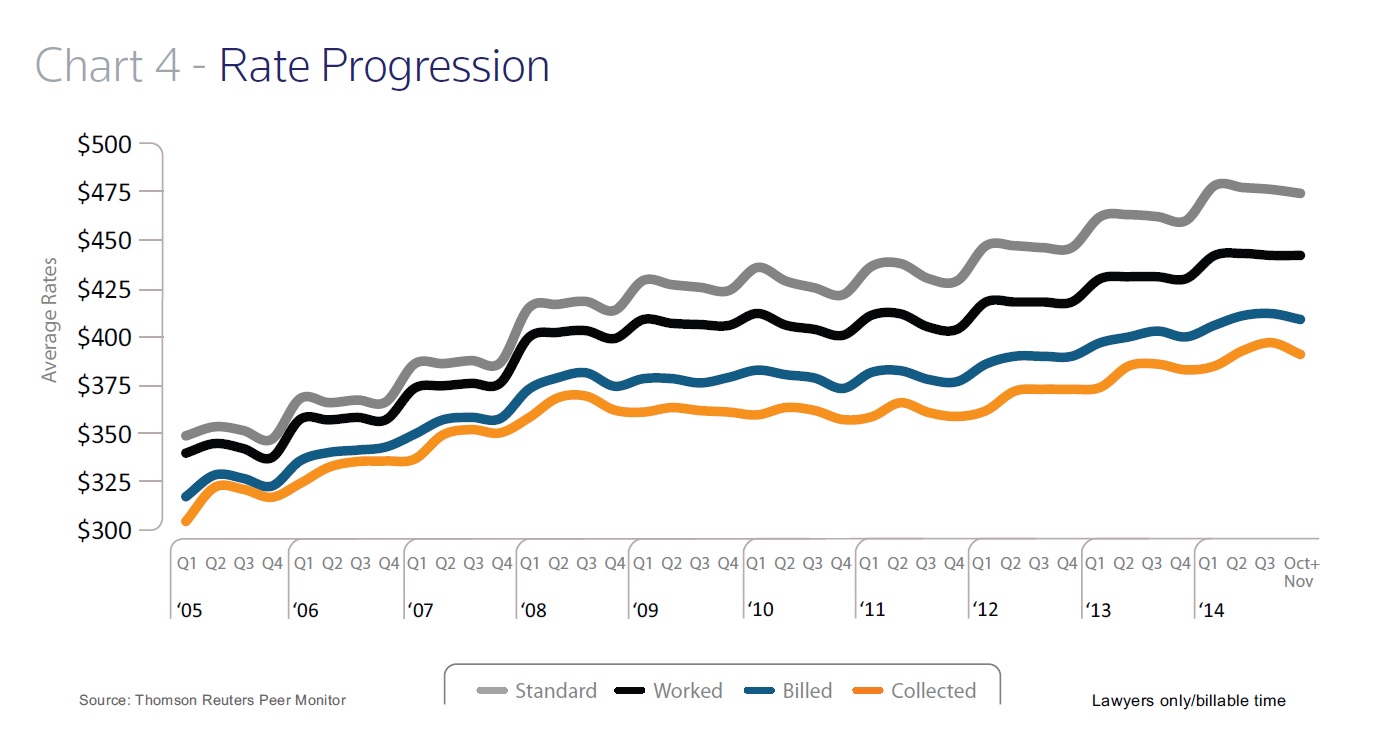
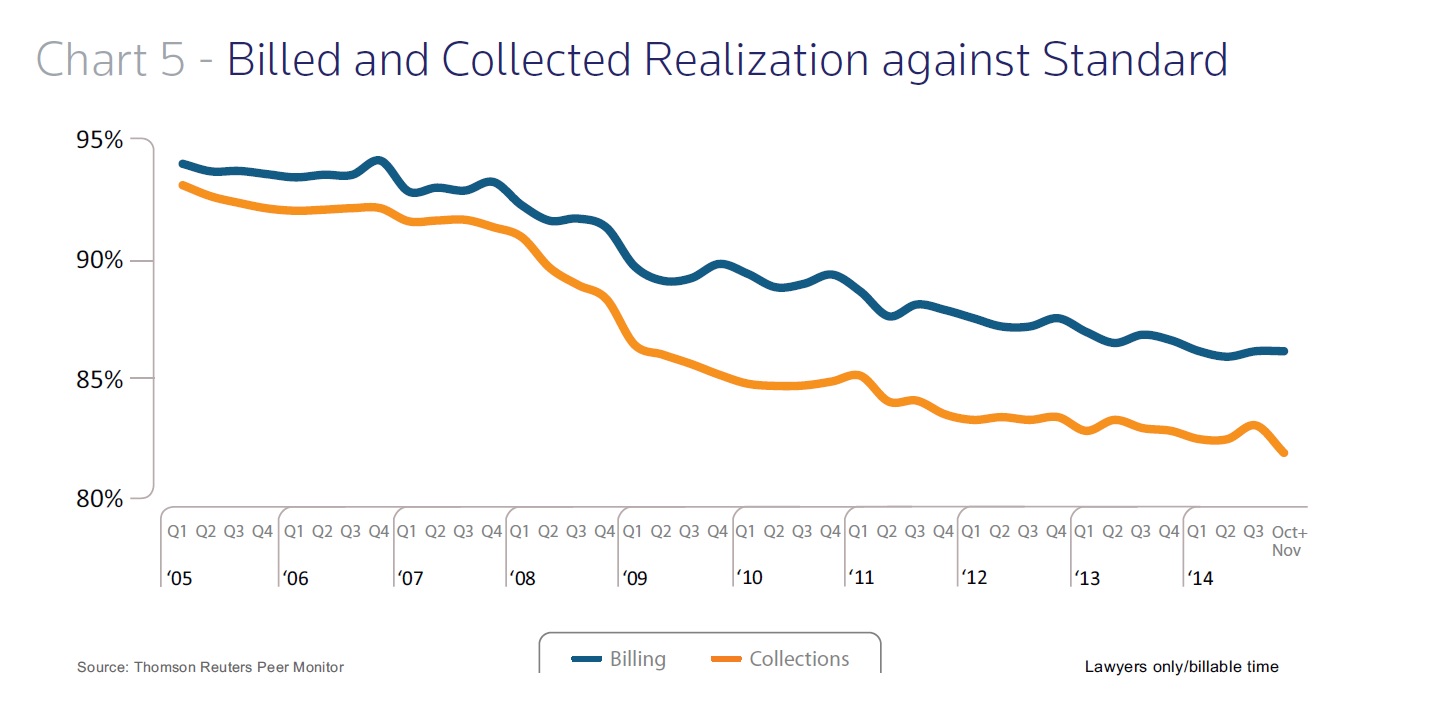
chart 4


chart 5

Those charts don’t make for pretty reading.

So when, as the article reports:

“…firms realise this is not going to be an easy sell to clients who are likely to negotiate hard to keep fees down, so their approach to increasing charge out rates is likely to be softly softly, rather than gung-ho”

my response would be: “why bother?”.

Instead,

  • try keeping your charge-out rate the same over the next 12 months;
  • try not to give discounts;
  • try to increase your realisation rate (by 3 to 5 cents in the dollar);
  • try to reduce your lock-up days;

and see where you end up.

You may just find that has a better impact on your partner profitability numbers than the likely impact that is going to come your way when you go annoying and off-siding your clients with the almost obligatory 1 July 10% rate increase letter.

But I could be wrong…

Your law firm’s brand recognition: How much does it really matter?

Business Development image

Earlier today Dr George Beaton (@grbeaton_law), Partner in Beaton Capital and an associate professor at the University of Melbourne, posted the following question to Twitter:

“Which firm is the ‘world’s strongest’? Skadden or Baker & McKenzie or Jones Day. Confusing”

George I

With a twitter pic link to an article on the Global Legal Post website that contains links to the following “Related stories”:

George II

Leaving aside the issue of financial strength, as George’s tweet clearly infers brand strength, the question I always ask when I see news items and survey responses of this nature is this:

Does it really matter?

And the answer to that really depends on what my firm’s overall strategy is.

Taking a step back, whenever I’m asked in my role as a business development consultant by law firm partners of the importance of such survey findings I will often respond by asking them the following question in return:

Imagine we are on a long distance flight on an important business route – say Sydney to London or Tokyo to New York. Now, say I give out a questionnaire to all 300 plus passengers on that plane asking them the simple question of whether or not they have heard of your firm. Would you prefer:

A. a greater percentage of passengers in first class to have heard of you?

B. a greater percentage of passengers in business class to have heard of you? 0r

C. a greater percentage of passengers in economy class to have heard of you?

Now if your firm’s business plan is to be doing “premium work for premium clients”, then my guess is you’d want a greater percentage of first class passengers to have heard of you. Similarly, if your business plan is to be working with the top ASX 200 companies, then I would hazard a guess you would want to be known by both first class and business class passengers, with the edge being on the greater brand recognition among the business class passengers. Finally, if your firm’s business plan is to be a leading B2C law firm, that I’m guessing you wouldn’t mind if your brand is widely recognised by the economy class passengers.

A very simplistic way of looking at this issue? Very much so.

But, at the end of the day, despite headlines that read ‘Top legal brands grow 45pc faster than others over last four years‘, I’m very much of the view that surveys of this nature fail to ask a more critical question, namely:

Do you regularly, or have you ever, instructed one or more of these firms you have heard of in the last three years?

Because, does it really matter if you have heard of me but never given me any work (ie, fed me)?

And all of this is before we get into the even more interesting discussion of whether or not you instruct individual lawyers (lawyer name [brand] recognition) – either at my firm or elsewhere – regardless of which firm they work for (lateral hire movements)?

After all, we have a long flight ahead of us…

Beware of wolves in sheep’s clothing

Business Development image

“Beware of the false prophets, who come to you in sheep’s clothing, but inwardly are ravenous wolves.” – Matthew 7:15

It might seem a little melodramatic to start a business development related post off with a biblical reference, but when the global leader of EY Law, Cornelius Grossman, says “I don’t think any firm should feel threatened“, vis-à-vis the march of accounting firms into the legal space, and particularly why law firms have nothing to fear from accountants practising law, it seems entirely appropriate.

On further reading, the firms Grossman says he is refusing to target – and thus by extension don’t need to feel threatened by the continued march of accountants into this space – are those doing “the highest level – “bet the company” – work and premier corporate clients” and who “have established their brands over hundreds of years…

In other words, so-called Magic Circle firms, their work and client base are safe from the invasion.

But, as Grossman then goes on to say in this legalweek.com article:

“he believes EY Law will succeed with multi-disciplinary teams doing mid-market transactional work”.

adding further that:

“We [EY Law] want to be known for compliance jobs that span over tens of jurisdictions and for large international reorgansiations.”

In other words, the work that just about 80 per cent of us have been trying very hard to secure for a couple of decades now (and in many case incurring significant losses while we try and secure this work)!

So, while Grossman may believe that:

“The threat of accounting firms to the legal market is overstated.”

and that:

“There’s so much work out there that we all compete for – I don’t think any firm in particular should feel threatened by that.”

unless you work for an elite law firm, I would like to suggest that you be a tad weary of wolves in sheep’s clothing telling you that there really is nothing to be overly concerned about and that there really is enough food out there for all of us to feed on.

How often do you let your clients know the value you provide to them?

Business Development image

Based on interviews with 188 independent lawyers and more than 500 clients, the LexisNexis Bellwether Report 2015: the Age of the Client (published earlier this week) found that:

“80% of lawyers think they’re delivering above average service…

… but only …

…40% of clients say they’re receiving it.”

What does this mean?

Well, either:

  1. You’re not as good as you think you are; or
  2. You’re not communicating well enough to your clients the value you bring to the transaction/relationship.

I’ll leave it for you to decide which you think applies to you.

CommBank Legal Market Pulse report – Q3 2014/15

Business Development image

The third quarter (Q3) FY2015 edition of the CommBank Australian Legal Market Pulse Report (Report), with research conducted by Beaton Research + Consulting,  has just been published.

As usual, the Report provides useful insights into the latest thinking of Australian law firm managing partners/leadership, as well as the trends and developments impacting on the Australian private practice legal industry sector.

Interesting outtakes from the latest edition of the Report include:

  • although short-term (next 12 months) economic confidence is fairly dire, the long-term (24 months+) outlook is very positive.
  • surprisingly, given the lack of confidence in short-term economic conditions, every single top-tier surveyed firm is forecasting higher revenue in the next six months. As Marc Totaro’s introduction covers, top-tier firms expect this [next six months] revenue growth to come from Europe, Asia and Sydney; but this paints a little too rosy a picture to me.
  • both top-tier (67%) and mid-tier (47%) firms anticipate seeing revenue growth coming from their employment teams.
  • insurance (60%) related work gets the nod as the expected highest revenue growth area for mid-tier firms. While the Report doesn’t elaborate on whether this is claims related or commercial work, the recent re-jig in the market – with insurance teams moving from the top end of town firms to mid-tier firms – must certainly account for some of this positivity. This is probably also reflected in the fact that top-tier firms surveyed forecast a fall in their insurance practice revenue over the next six months.
  • excepted revenue growth within taxation (50%) ranked higher than I would have guessed among top-tier firms; but maybe this is more reflective of the time of year (Q3).
  • one possible hidden indicator in the Report: mid-tier firms seem more optimistic about getting their hands on “construction, engineering and major infrastructure” (50%) work than top-tier firms – who don’t rank this area in their top 3 revenue growth practices. On the flip-side, clearly the recent M&A work in “IT, telecoms and media” (think 9 Network and iiNet) has been going to the top-end of town with 67% of top-tier firms expecting this practice area to be one of their highest growth areas.
  • top-tier firms forecast revenue growth in UK/Europe, Asia, Brisbane, Canberra, Melbourne and Sydney, but revenue in both Adelaide and Perth are predicted to contract.

The Report also provides forecasts on expected realisation rates (and if you thought these couldn’t possibly get any worse, think again), expenses* and outsourcing.

But, saving the best to last, probably the biggest shock the Report contains is the forecasted change in staffing; and, in particular, the bloodbath that is anticipated to take place within the partnership ranks of top-tier firms. And to be clear, a 33% and 67% forecasted decline in net proportion of equity and salaried partners respectively can only be described as a “bloodbath”!

As usual, I suggest you download and read the Report – it’ll make for an interesting weekend read.

* on a personal note, I see there is a forecasted 17% reduction in “Marketing and Business Development” expense by top-tier firms in the next six months. I can only hope that doesn’t come about.

Report: A snapshot of Asian Australian diversity in the Australian legal profession

Business Development image

Last night – Tuesday 14 April 2015 – saw the publication of “The Australian Legal Profession: A snapshot of Asian Australian diversity in 2015” (Report) an inaugural report prepared by the Asian Australian Lawyers Association.

At 8 pages, the Report is exactly what it says it is – a snapshot. Moreover, its a snapshot of the profession and doesn’t include information about the number of Asian Australians there are studying law at university (nor for that matter does it include in-house lawyer numbers).

Having said all that, in my opinion the infographic on page 4 of the Report tells a more compelling story than any 1,000 page report into diversity could.

Asking the question:

Is there a “bamboo ceiling”

the infographic details that:

While Asian Australians make up 9.6% of Australia’s population, Asian Australians account for a mere 3.1% of law firm partners (incredibly these numbers are actually worse for barristers and the judiciary). If that were not bad enough, 50 (yes, 50) “medium” (10-40 partners) and “large” (>40 partners) law firms in Australia have no (as in zero or “0”) Asian Australians in their partnership.

To be clear, this isn’t limited to female Asian Australian partners, but Asian Australians period.

While, by its own admission, limited by the nature of the subject matter – and there being relatively basic public material available -, thus great care needing to be taken in interpreting the data, I’m left asking: “how can this be?”.

And it is worth restating:

out of 97 ‘National’ and ‘International’ law firms in Australia, with collectively 4,100 partners, a mere 125 are identified as being Asian Australians.

In an era where almost every medium to large law firm in Australia is on record as [strategically] actively seeking work from the Asia Pacific Region, the findings in this Report are nothing short of bewildering and staggering.

However, as disappointing as the findings are, publication of the Report is nevertheless important if, as is hoped, it forms the start of “a constructive dialogue for the legal profession in Australia.” A dialogue that is clearly well overdue.

My only hope is that any future report extend the survey findings to include a breakdown of male and female Asian Australian law firm partners. Because, if anecdotal evidence from my own life is anything to go by, female Asian Australian law firm partners are a very rare breed indeed.

*Disclosure: As the proud husband of an Asian Australian lawyer and the father of an Asian Australian daughter, I have more than a vested interest in the subject matter of this post.

The two types of efficiencies law firm associates need to become familiar with…

Business Development image

Really interesting article [‘What Associates Should Know About In-House Rates and Efficiencies‘] by Gina F. Rubel was published overnight (7 April 2015) on The Legal Intelligencer website – discussing the two types of efficiencies that law firm associates should become familiar with – contains a gem of a quote from an in-house general counsel that I wanted to share/pass on.

First, to put some context around the quote below by Gino Benedetti, as Rubel states:

“There are two types of efficiencies with which lawyers need to be familiar. The first is general efficiency, which is the state or quality of being efficient and the actions designed to achieve optimal results. The second is economic efficiency, which requires optimal production and distribution of a firm’s resources.”

And while both are extremely important to in-house counsel, the following quote in the article by Gino Benedetti, General Counsel of SEPTA, should give some indication to private practice law firm associates which of the two bears more commercial importance to their in-house clients:

“Associates should understand that every case does not require a full-court press,” said Gino Benedetti, general counsel of SEPTA. “Associates add value when they think creatively by identifying the core issue in dispute and focus their case work on things that impact that issue. Often, associates work on an aspect of the case that does not have any meaningful impact on the ultimate outcome. So, associates should appreciate that their time may be less expensive, but that does not justify inefficiency. Associates should communicate often with the partner or the client directly so that the client’s objective is understood and the work is driven by that objective.”

If you haven’t already, I’d like to suggest you go over and read the entire article. It’s full of sage advice from several in-house GCs.

In the meantime, if you are a private practice law firm associate, the next time your supervising partner asks you to undertake a task on behalf of your client why not ask yourself which type of the two types of efficiency you are going to bring to the task…?

Pinsent Masons joins the #Auslaw party!

Business Development image

Some 15 months (December 2013) after Pinsent Masons initially appointed Maddocks ex-chief executive David Rennick to lead the firm’s review of growth opportunities in Australia, and three months after the vote to appoint John Cleland as new global managing partner that appears to have confirmed the firm’s stated international growth strategy , Pinsent Masons has, today, announced that it will launch a 5 partner led local Australian practice in May of this year with offices in Sydney and Melbourne that will initially focus on infrastructure related work.

Given the firm’s overall strength in infrastructure related work in Asia – partner-in-charge of Asia Ian Laing has significant PPP and PFI experience – a strategic focus in this area would appear to be sensible.

That said, Pinsent Masons decision to open here (with an as yet undeclared number of lawyers and support staff) does nothing to deter from the fact that the legal market in Australia is a very competitive and crowded one, a trend that is likely only going to increase with the growing interest of international brands – so the very best of luck to this firm going forward and welcome to the Auslaw party!

The rising demand for flexible legal resourcing

Business Development image

Lawyers On Demand (LOD) (the so-called ‘alternative legal services provider’ backed by UK-based firm Berwin Leighton Paisner (BLP))  have released data – akin to an annual report – that indicates there is a growing need for ‘flexible resourcing’ within the UK legal market.

Among the more interesting data to be released is that:

  • LOD’s turnover has increased by more than 500% (to circa £9m) in the past four years.
  • LOD’s ‘On Call’ service (launched in June 2013) has completed more than 70 assignments in its first 18 months.
  • more than 150 On Call lawyers have now completed LOD assigned assignments for more than 15 different law firms.
  • LOD is offering clients retainer arrangement of between £2,000 to £50,000 per month, depending on their current resourcing needs.
  • surging demand for On Call lawyers to work on specific transactions has led to the launch of On Call ‘transaction teams’.

Notably, LOD said the On Call teams:

“allowed private practice clients to scale up quickly and cost effectively, protecting their profitability on transactions and responding to client demand.”

So, what has all this to do with the Australian legal market you may ask?

Well, as it happens a number of ‘flexible legal resourcing’ providers have had ‘soft’ launches in the local market of late, including:

  • Crowd & Co – whose tag-line is “Saving you time for what really matters”, and
  • Lexvoco – with a tag-line of “Law on call”.

Both of which are in addition to the recent launch of Orbit by Corrs Chambers Westgarth, and both of which look to offer what appear to be very similar services to LOD’s On Call.

Add to this the recent (2 February 2015) decision by Allen & Overy to expand its ‘Peerpoint’ service to the Hong Kong market, and I think we can safely say that there is clearly a rising demand for flexible legal resourcing – globally, regionally, as well as locally here in Australia – and that all that now remains is for someone to come up with the appropriate acronym.

Q2 2014/15 CommBank Legal Market Pulse report

Business Development image

The CommBank Legal Market Pulse report for Quarter 2 2014/15, conducted by Beaton Research + Consulting,  has been published.  Providing useful insights into the latest trends and developments impacting on the Australian legal industry, this report has rapidly cemented itself as a staple among serious legal business developers in Australia.

Interesting outtakes from the latest report include:

  • unsurprisingly, given the continuing political uncertainty and falling commodity prices, many law firm leader believe there may well be a downturn in the broader economy over the next 12 months.
  • one in three firms are looking to expand geographically by opening new offices, with an emphasis on Perth, Brisbane and Canberra being the locations of choice. This is an interesting development as it had been the stated strategy of many firms in Australia for a long time not to expand outside of their geographic stronghold base. For example, for a long time HDY were only ever going to be a Sydney firm serving national clients. Now they have an office in Brisbane. Likewise for G&T (new offices in Melbourne and Perth). What I would be interested to find out though is how much of this expansion is self-driven and how much of it is been driven by major clients looking to rationalise the number of law firms they use? If that question was asked, I suspect we may find that this trend is more client-driven than firm-driven.
  • Asia at 89%, UK/EU at 67% and Brisbane at 52% are seen as being the geographic areas with the highest revenue growth expectations. Sorry but I find this nothing short of astonishing. Have any of these respondent law firms looked at how crowded the Brisbane and Asian legal markets are? And wasn’t it only a few months ago that PwC were reporting that return on equity for Asian law practices was the lowest globally (at somewhere in the 20% range). [that said, Clifford Chance did recently announce a desire to increase revenue in Asia by 25%]
  • expected changes in realised rates is a 1% (+) increase. Pathetic! Might I suggest the firms concerned consider not increasing their rates by 5-10% this year and instead concentrate on trying to get more than 80c in the $ in realised billing rates.
  • negotiating price with clients, at 81%, is seen as the biggest business challenge facing law firms. Here, I would hazard a guess that negotiating the price we want from our clients is probably the real business challenge as it would seem that price negotiations in law firms is a one way conversation at the moment.
  • the practice area with the highest revenue growth expectations is Government (at 55%). With the announced forthcoming closure of the Australian Government Solicitor potentially putting up for grabs around $111.3 million in revenue for private practice law firms, perceived growth in this sector shouldn’t be too surprising. What does remain to be seen is how much of this pie firms other than Clayton Utz (at 11% for 2013-14)  can get their hands on.
  • 54% of law firms surveyed believe revenue from “non-legal services” will increase over the next 2 years. While I was unable to find a definition of “non-legal services”, the relatively low (at 54%) number of law firm leaders who saw growth in revenue in this area does surprise me. This is especially so if services such as the recently launched Orbit by Corrs Chambers Westgarth is seeing as constituting “non legal services” (in that it is not core legal advisory work).
  • and finally, 70% of law firms see “recruiting partners and staff from competitors in the new location” as being the most likely method of geographic expansion, while only 30% saw this geographic expansion occurring as a result of a “merger with an existing firm” – so be on the lookout for 2015 being a very business year for lateral hires!

If you haven’t already done so, can I suggest you download a copy of the report. It really is an interest read.