The Association of Corporate Council (ACC) – the worldwide association that promotes the interests of in-house counsel – recently published its ‘10 Key Findings from the ACC CLO Survey 2024‘.
While I have not read the full report, there are some very interesting take-outs from the Executive Summary, including:
58 percent of [in-house] departments have been impacted by law firm rate hikes
42 percent of CLOs say their legal department received a cost cutting mandate over the past year
23 percent of in-house say that rate increases have been difficult to manage
only 9 percent are “very confident” in their organization’s ability to mitigate emerging data risks
The top 3 issues that keep CLOs up at night are not what you would think [well, maybe one of them!]
The importance of ESG would appear to be a little over cooked – but…
…I’ll leave you with this one: 63 percent of CLOs say they are seeking to develop greater business acumen among the lawyers in their department – Good luck with that one!
Check out the link above to read more and as always if need any help feel free to get in touch.
The number of senior business development people, including Director level roles, I have spoken to over the years who “fell” into working in business development roles for professional services firms is remarkable! Yes, in most cases they had a relevant applicable skill-set that could be transferred and used in the new role: whether that be as an ex-lawyer, marketing graduate or communications professional; but, by and large, I think it’s fair to say that almost none of us saw a career advisor at school and asked what undergraduate and post graduate degrees we need in order to have a career in business development for a professional services firm*.
So I was really glad to read today, via the Legal Cheek blog, that Slaughter and May are to launch a business services grad scheme.
Although Slaughters are one of the few Magic Circle firms I never worked at or for, I have really admired them from the sidelines. Their focus on their core strategy is commendable. All of which, in my opinion, is reflected in their newly announce two year ‘Business Services Academy‘ program.
In a similar vein to grad rotations, Legal Cheek is reporting that the Academy program will consist of four rotations of six months each among:
people and operations
technology legal ops and project management; and
clients and business development.
Now, the very clever people you are, you’re think 4 into 3 doesn’t go – and you would be right. But, apparently the forth rotation is with the team you have enjoyed the most on your previous rotations and want to consider a career with, and I kind of like that!
So once again, the team at Slaughter and May are blazing a path, but please do we really need to say this:
It’s worth noting that this scheme does not lead to qualification as a solicitor.
Anyhow, if you are not fortunate enough to work at Slaughters – or, as Legal Cheek points out Addleshaw Goddard or DWF (who have similar programs), and really need to learn a thing or two about how business development in law firms actually works in practice, reach out to me!
* I would also add that a lot of that same thinking applies to lawyers trying to do business development, in that they have had no formal training in this skill!
Law firms that conduct formal client feedback programs can earn nearly twice the share of a client’s external legal spend than a firm not engaging in feedback;
in 2023, only 27% of clients were asked to participate in a client feedback program by their outside law firms.
Let’s get a realty check on that: Law firms that have a client experience (CX) feedback program can earn nearly twice the share of a client’s wallet, but less than one in three clients have been asked to participate in a client feedback program.
In business development we often talk about “low hanging fruit” and this seems like a ‘no brainer’ to me!
Get in touch if this is something that interests you. And, frankly, why should it not!
3229 days – on average that’s how long it will take you to make partnership in 2023. And when I say “partnership”, I’m not talking about equity partnership.
Last week (15 August 2023), Marlene Gebauer and Greg Lambert interviewed Laura Leopard, founder and CEO of Leopard Solutions, on their ‘Geek in Review‘ podcast. It’s a really interesting chat around law firm partner succession plans (or lack thereof), which was actually the primary topic of their conversation.
But, it was an insight that Laura shared at the 13 minutes and 21 second mark that had my hair standing up:
In 2023, on average, it takes 3229 days for a new entry level hire to make partnership.
Two things to note here:
this figure reflects those making partnership in 2023 (as opposed to new entry level hires in 2023 – see below for why this is important)
as Laura and Greg discuss, this reflects ‘partnership’ (i.e., salary partner), not equity; which could take you a further three years to acquire
So what? After all, this information is useless unless put into context. What I mean here is this: Has this number changed at all over the past 10 years?
In 2012, on average, it took a new entry level hire 1353 days to make partnership
On average then it is now [2023] taking new entrants about 5 years longer to make partnership than 10 years ago!
What can you do to make the path to partnership shorter?
Okay, you’ve decided you want to be a partner: What can you do to make the path to partnership – which, let’s face it, is growing by about 6 months every year – easier / quicker?
Here are a few tips you may want to consider to help make that happen:
Know what your offering / sector expertise is
Learn your firm’s economics / financial metrics – what is realization / utilization / leverage / write-offs / average billing rates? If you don’t know you need to learn this quick! “Play the game”
Look at / speak to your existing network – both internal (referrals) and external (referrals and clients)
Grow your professional network – for example, join industry associations and attend relevant industry conferences
Speak at industry conferences / events (that are relevant to your core area)
Build your personal thought-leadership brand (LinkedIn)
Understand and communicate your value proposition
Most importantly though, have a plan and if you think it will help hire a business development mentor / coach to help you reach your partnership goal.
On the rules of compound interest, a one hour talk each month with someone who knows how to build a book of business will take you a long way to achieving your goals quicker than the industry norms.
As always, feel free to reach out to me for a free chat if you want to talk through how I can help with this.
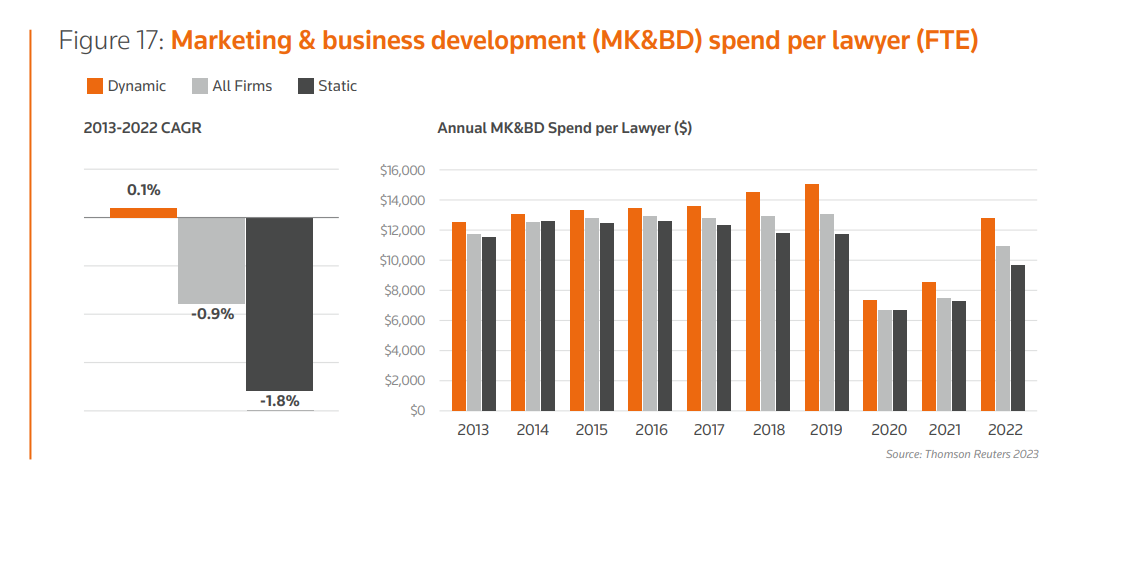
The numbers have been crunched and the results are in: ‘Dynamic Law Firms’ invest considerably more in their business development and marketing activities/departments than static firms are willing to do.
According to the latest (8th) iteration of Thomson Reuters Institute’s 2023 Dynamic Law Firms Report, Dynamic Law Firms consistently invest greater sums in their business development and marketing teams than Static Law Firms:
As you can see from the over graph, in 2022, on average, this investment by Dynamic Law Firms in their business development and marketing teams accounted to over $12,000 per lawyer. Roughly $2,500 more per lawyer than Static Law Firms.
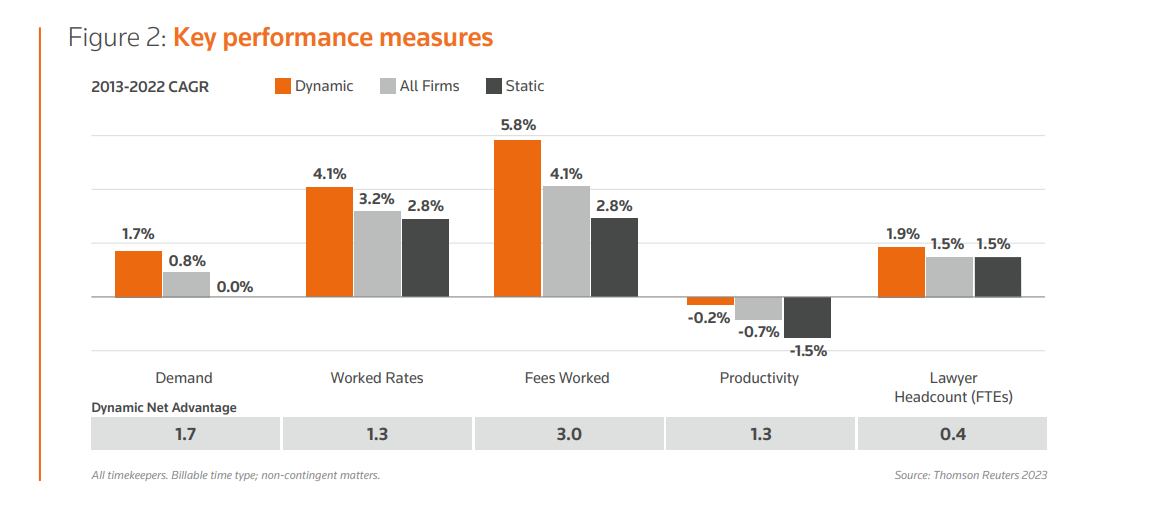
Importantly, this investment in business development pays off:
With Dynamic Law Firms consistently outpacing Static Firms in all growth Key Performance Measures; but, most notably from a business development perspective, in both ‘worked rates’ and ‘fees worked’.
So why is this? After all, business development and marketing is a ‘cost-center’.
Well, as the Report itself states:
“The first goal of MK&BD investment is to raise top-of-mind awareness of the law firm.
Research conducted over the course of many years by the Thomson Reuters Institute has shown that top-of-mind awareness is a vital first step toward winning work – a process that will see a firm move along a continuum from awareness to being viewed favourably, to being considered for and ultimately winning work, and hopefully, to a point where the firm has gained enough experience with the client that they garner credibility in the board room and can begin to box out competitors.”
A fact backed-up by the authors of Simple Heuristics who, in their principle of “recognition” [firm brand or lawyer], state that recognition is number one in any client’s decision process around whether or not to buy something.
And so it goes without saying that this ‘awareness‘ factor is critical in the ‘buying cycle’. If we don’t have this advantage, then we need to hope to hell the other providers aren’t a known commodity so we can proceed to the next level in the buyer’s decision process (typically experience – have they done this before?; then can I trust them not to mess this up and make me look stupid! – SIDE NOTE: price isn’t in the top 3 decision making selection criteria.).
Which is why, if you want to make sure your firm stays one step ahead of its competition, you actually need to be investing more, not less, in your business development team right now.
Yep, the evidence is in. It’s undisputed. Business Development and Marketing is not a ‘cost center’ (not that I ever thought it was). They not only pay for themselves, but they ensure your firms stays ahead of its competitors and earns more $$$s.
So the next time you think to yourself: “I need to cut costs, I’ll cut my business development and marketing budget” – I’m here to tell you that’s dumb – think again, because not only will it hurt you but it will take you on a journey to blandness.
As always, feel free to reach out to me for a chat if you want to talk through how I can help with this.
Very sage advice from Seth Godin today for any new partners recently made up in the July promotions here in Australia, or anyone trying to do business development in today’s crazy world for that matter:
The first thing to do when thinking about starting a project, before you invest in systems design, infrastructure or fancy tools, is to practice getting some customers. And the second thing to do is to find out what it’s like to delight or disappoint those customers.
As always, feel free to reach out to me for a chat if you’re struggling to get to grips with this issue.
Ever wondered if there is a difference between ‘customer service’ and ‘customer experience’?
I was fortunate enough to come across this quote by Paul Roberts, CEO at My Customer Lens that, frankly, sums it up better than anyone else I have seen lately:
“It’s important to define the difference between customer service and customer experience. I like to define customer service as what you do, and customer experience is how you make people feel.”
Too often in professional services firms we concentrate on the ‘customer service’ at the expense of the ‘customer experience’; when the reality is that we should be much more focused on the customer experience than we are on the customer service.
As the article states:
“Improving the client experience is about looking at the entire client journey, from initial enquiry through to case completion, and beyond. It’s a rethink and review of every customer touchpoint throughout your organisation; from the way the phone is answered, to your hold music, reception waiting room and website home page.”
Spot on advice.
If you or your firm is struggling to get a grip with this, feel free to reach out to me for a chat.








 RWS_01's B[D]log