General business development issues

Is putting profit before culture such a bad thing for law firms?

In 2004, while working at Linklaters, Tony Angel – the then recently appointed Managing Partner of the firm – introduced a new strategic direction that was to become known as ‘Clear Blue Water-– A Vision for Linklaters in 2007‘. Much as was being advocated in Renée Mauborgne and W. Chan Kim’s Blue Ocean Strategy, published around the same time, the intention of Angel’s Clear Blue Water strategy was to create a clear space (as opposed to red oceans) between the firm and it rivals.

For many of us who worked in the firm at the time, this represented a high-water mark. It was made very clear to all that Linklaters was now very much a business: profit trumped culture.

Sure culture was nice to have, but not if it had any material impact on profit.

But was this such a bad thing?

As someone who lived through the 2004-2007 era at Linklaters, I can honestly say “no”.

To be clear, there is little doubt in my mind the firm became more “professional”. Many of the business development, marketing and knowledge management work that had traditionally been done by lawyers was taken off them and given to dedicated teams. The firm introduced key account programs around their top clients. Blue Flag (Linklaters online client portal – that included early use of HotDocs) was a flagship program. Precedents and ClauseBank were core strategic projects.

But importantly, financial analysis was undertaken to determine the difference between revenue and profit and how both revenue and profit could be increased (which didn’t necessarily mean a reduction in costs – for example, the business case behind Blue Flag was the first example of an alternative revenue stream I saw in a law firm).

All of this was then extended to sectors when clients started to say they valued, and appreciated, sector specialists (Linklaters was the first place I worked at that had a virtual practice – The Indian Desk, back in 2005-ish which operated from London, New York, Singapore and Dubai).

Despite – or even because of – an overall strategy to significantly increase profit, large amounts of money were invested in putting in place strategic teams that could help implement and execute on this strategy. Professional KM, marketing and business development people came in to the firm from all walks of life and people who had never worked in professional services firms previously were now doing so.

Importantly, my personal experience was that their voices, counselling and advices were being taken onboard. Sure partners may disagree – and ultimately we all knew that the buck stopped with them, but it was also made clear that they appreciated and valued our input.

Another important aspect of Angel’s Clear Blue Water strategy though was transparency.

Everybody in the firm knew what we were trying to achieve. We knew what was required to get us there (including I might add an absolute understanding that this would involve an incredible amount of hard work). We knew how we were tracking and which parts of the business were struggling to achieve their goals. From my memory (and it was 10 years ago now), this wasn’t done with malice but so that we knew who needed help.

In short, the strategy bred a culture. A culture that many who were not in the firm may have considered elitist, but a culture nonetheless: to be at Linklaters at that time was to know you worked among the best (and if you doubt that, track the CVs of many of the leading BD/Pricing/KM people around the world and see who they worked for during that time).

So why, 10 years after I left, have I decided to bring this all up now?

HSF

The answer to that lies in the decision this week by Herbert Smith Freehills (HSF) to open a second office in Sydney.

This second office will be at 66 Talavera Road, Macquarie Park, while the principal office will remain at 161 Castlereagh Street. It is currently being reported that between 200 and 300 support staff (that may not – for now – include BD people) will be moved to this Macquarie Park office.

To my mind, this move eradicates all pretence of a ‘one firm’ culture having anything to do with the running of this firm. Conversely, it cements the ‘us’ and ‘them’ culture. If you are in Castlereigh Street, you’re ‘in’. And if you are in Macquarie Park, well you’re not! Worse, if you get moved from Castlereigh Street to Macquarie Park, you could consider it a demotion (especially given there will be no train line servicing that office for 10 months in the next year or so!).

But again, as someone who has advocated for the outsourcing of support services in law firms (in much the same way as a number of firms in Asia did post the Asian Financial Crisis) for more than 10 years the question should be: is this such a bad thing?

And my answer to that is “no”.

But my answer comes with an important caveat from someone who has been through similar strategic processes, and that is this: everyone at the firm in now on notice – perform, or you’ll be in Macquarie Park – or even out altogether – before you know it!

rws_01

Report: Billable hour remains the pricing method of choice for Australian law firms

[This post first appeared on my LinkedIn page on Tuesday 14 November 2017]

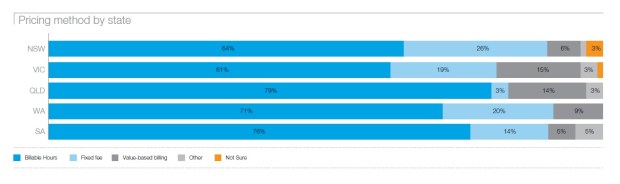
Despite the rhetoric we read each and every day around NewLaw, law firm innovation, value-based pricing, fixed fees and alternative fee arrangements, Macquarie Bank’s recently published ‘2017 Legal Benchmarking Results – An industry in transition’ report confirms that the crusty old ‘billable hour’ remains the pricing method of choice for the majority of Australian law firms.

While the report evidences a ‘gradual transition’ away from the billable hour – with 33% of law firms stating that they planned to use a method other than billable hours as their primary pricing method going forward, the term ‘gradual’ here would probably be better described as ‘glacial’ – as this figure is up a mere 2% since 2013.

fees

Interestingly, the report breaks down the preferred pricing method of choice by State (see image above), with Victoria and Queensland leading the way on ‘value-based billing’ (15% and 14% respectively) and NSW smashing it on ‘fixed fees’ (at 26% – which looks to be mostly property related matters) [Anyone else out there as surprised as me with the QLD result?].

Disappointedly, ‘value-based pricing’ is not the term used in the report (and thus I have to assume not asked) as ‘billing’ implies an after the fact approach which almost certainly means there has been no upfront discussion around needs, process maps, project management, white-boarding or any of the other methods of communicating a mutual understand of ‘value’ before a task is undertaken.

At the end of the day though, this report seems to show/indicate that roughly 2 out of every 3 matters undertaken in Australian law firms is being done ‘on the clock’ (i.e. billable hour). And while it doesn’t show what the realisation rates are around this method of pricing, it does provide evidence that law remains a highly profitable business – thus, by extension this method of pricing.

Overall though I found reading the results in this report depressing.

Why?

Because I actually enjoy reading all that rhetoric every morning about how law is changing and becoming more innovative – and to be confronted with evidence this may not actually be the case is, well, depressing.

rws_01

[ps, if you haven’t downloaded and read the report – do!]

Does competitive tendering deliver best value for money outcomes?

“Efficiency isn’t just about doing more for less. It is about finding the right balance between money, time and quality.”

– [UK] Network Rail Infrastructure General Counsel of routes, Dan Kayle

One of the biggest challenges a General Counsel faces these days is finding a way for his/her company to procure legal services in a way that:

  • ensures a quality service, at
  • a price that is fair to the company, while
  • ensuring that the service provider remains a viable and ongoing business.

For a number of years in Australia the primary mechanism for achieving this has been ‘competitive tendering’. But evidence is now coming to light that competitive tendering may not actually be delivering  the best value for money outcomes that clients had hoped for. Which raises the question:

Is competitive tendering the best way to procure legal services? And if not, what, if any, are the alternatives?

For those (living under a rock) who may not be aware, ‘competitive tendering’ in Australia comes in many guises: panel, project, parcel and combinations of all of these.

For the purposes of this post however, I’m going to state that ‘competitive tendering’ happens whenever a company ‘pitches’ its service needs among one or more of its providers. I’m also going to extend this by saying that the evaluation weighting of the winner of this process favours ‘price’ (read lower) over ‘outcomes’ (read performance).

And herein lies the flaw with competitive tendering that has prompt this post: because in deciding to go with one service provider over another based on an evaluation criteria of price, it is arguable that such a decision comes at the cost of quality.

To be clear, I am not suggesting that legal service providers purposely undermine the quality of the advice they give. Nor am I saying that there is a lack of understanding that there is a trade-off between cost and quality – after all, you don’t get a Rolls Royce at the price of a Mazda and most lawyers today know that.

What I will suggest however is that if law firms are being asked to go through a competitive tender process, which is often followed by a BAFO (Best And Final Offer) process, then in-house counsel have to accept that there will be a fall off in the quality of the service they receive.

Which leads me to this: Is there a better way of doing this?

Negotiated Contracts

I would argue that if you’re trying to achieve an outcome at a price that is agreeable to your company, then negotiated contracts far out-weigh competitive tenders.

To be clear, negotiated contacts can – and often are – competitive.

But the biggest difference between a competitive tender and a negotiated contracts is that the client has pre-selected a set of achievable outcomes – with a group of providers that they believe can deliver on those outcomes.

And we can all work towards that (i.e. it is not all price driven; so-called ‘race to the bottom’).

+-ve / -ve debate

  • Competitive tenders stimulate and promote competitive behaviours. Among a group of adversarial and highly competitive lawyers, will this provide the best results for your company?
  • Costs associated with competitive tenders can be  enormous: is this the best way to conduct a relationship?
  • Competitive tenders deliver the most competitive outcome, which is not the necessarily the best value and price to your business.
  • Negotiated contracts can be the first step in setting out your Legal Project Management (LPM) approach to the matter.
  • Negotiated contracts facilitate a discussion around the client’s different value points.
  • Negotiated contracts allow all sides to come to a clear understanding of what the various expectations are.

Now don’t get me wrong, despite evidence showing that competitive tendering isn’t working, and that we continue to reward poor performance – provide it is done at the right price, all I’m asking is this:

Isn’t there a better way of doing this?

rws_01

Do you know who your competitors are?

In a highly competitive market such as the legal industry, understanding and knowing who your major competitors are is crucial to the successful identification and implementation of your firm’s strategy.

When assessing this issue, most of us naturally look outward at our traditional, and even new, market competitors. In short, we try, as best as we can, to compare apples with apples.

That’s why the publication of results from a new survey in yesterday’s Legal Futures, one of the UK’s leading legal news websites, makes for an interesting read. Because, to my mind, understanding and deciphering who your firm’s principal competitor is would seem to  remain a misunderstood issue.

Why do I say this?

Well, in the article Legal Futures (quoting from a recently published market survey) states that:

“more than two-thirds [of London City firms] see other professional services firms as the overwhelming competitive threat among recent entrants to the profession.”

By “other professional services firms“, what they mean is the Big 4 accountants.

While the re-emergence of “other professional services firms” (and for that matter so-called “new law” firms) is concerning, they are currently a long way from being the “overwhelming competitive threat” to law firms.

No, that title belongs to another group much closer to home: your clients.

With the level of work that clients are now taking back in-house, or not bothering to do at all, they are without doubt the “overwhelming competitive threat” to the current law firm business model. And, this is not cyclical but structural.

Crucially, understanding this is of paramount importance if firms wish to survive the next 5, 10, 15 years. Because it reshapes everything we do. How we try and win work. The type of work we are trying to win. And even the nature of the relationship we have with our client.

In the long term it will determine the way we measure and reward. It will dictate how we charge, and it will determine whether we succeed or fail.

And for good measure, here is another thing that is rapidly changing: who the client is can no longer be taken for granted or assumed. Because more often than not, it’s no longer the person you have the working relationship with.

rws_01

‘Coopetition’

“Coopetition” = Cooperating while competing.

I heard a new word today, ‘Coopetition‘.

In an article in Philippine publication Business Mirror, Stephanie Tomampos credits Philippine Science Secretary Fortunato T de la Pena with using the term during his keynote address at the opening ceremony of the 17th Conference of the Science Council of Asia at the Philippine International Convention Centre on June 14th.

Although not directed at lawyers, but at scientists who cooperate while competing for research funding, I thought the word summed up well the role of the modern law firm; where firms are increasing being asked to cooperate with each other in order to contribute towards inclusive overall development of the client’s business.

Whereas in the past this sort of cooperation may have been limited to unbundling, LPO or labour arbitrage, today cooperation between the various legal service providers of a client extends way, way beyond this.

We see it in the way firms are now required to cooperate with each with the IT platform(s)/environment the client uses. We see it in the way we pitch innovation to clients, where if we work with multiple firms servicing the client we cooperate with each other on innovative ways of doing the job. We see it in the way we are being asked to work with project teams, often with New Law providers such as Lawyers on Demand and Crowd & Co.

Driven largely by a need for cost efficiencies, what we are increasingly seeing is a demand by clients for a cohesive, inclusive, approach to their client experience (CX) from all of their legal service providers.

This means that while we very much remain competitors, in the new world order we need to cooperate with each other in order to be in a position to compete at all!

rws_01

How often does your law firm managing partner call clients to thank them for giving you instructions?

It may sound slightly crass, but when was the last time your firm’s Managing Partner phoned a client to thank them for giving you work? Indeed, have they ever phoned a client to say thanks for the work they give the firm?

Because, crass as it may sound, sometimes in life doing the really simple – right – things well gets lost in our haste to over complicate things and reinforce to all how important we are the role we play in this little merry-go-round.

All of this was brought home to me recently when reading an article on abovethelaw.com titled ‘Biglaw Idol’ — Or, How In-House Lawyers Actually Select Outside Counsel: Picking a law firm for a seven-figure engagement can take under five minutes by Stephen R Williams.

Stephen is in-house with a multi-facility hospital network in the US Midwest and in this article he sets out fairly succinctly and scarily (from an Australian business development perspective) near-verbatim transcript of a recent discussion on how the in-house team decided which private practice firm they would retain for “a rather sizable engagement” (the seven figure sum mentioned in the article’s title).

Turns out that once they had decided a select group of firms (5) who they thought could do the job, one of the deciding differentiators that set the winning firm out from the others was the fact that:

Their managing partner also called me this morning to thank me for considering them. He said he understood they may not be who we ultimately retain, but he appreciated the confidence we had in their firm for even considering them.

The GC’s response?

Well, it may surprise you:

GC: Wow, Managing Partner called? I passed over his shop a few months ago in favor of Biglaw 2 and thought he was still mad at me. I am impressed he called. Look, if we can’t get an answer from Biglaw 5 and Biglaw 4 is ready to go — I am signed-off, bring in Biglaw 4.

That Managing Partner just won his firm a seven figure engagement. With one phone call. And he didn’t even say thanks for hiring us. He said, “thanks for thinking about hiring us”. Pretty powerful stuff.

Food for thought…

rws_01

Defining success…

The latest Bellwether report from LexisNexis (The Art of Success: Why Independent Law Firms are Thriving) was published earlier this week.

As always, the Report is an interesting read (and I look forward to the next two publications later this year), but what caught my attention in this particular Report was the following definition of “success“:

Defining success

Most independent law firms see success as a trinity of three important elements:

  1. the quality of their expertise,

  2. solid commercial logic,

  3. commitment to treating staff and clients with respect.

Going on to say:

Being a ‘good’ lawyer isn’t just about knowing your law or being a skilled craftsman. It’s about understanding how to apply the law to serve your client’s business and personal needs. It’s also about exercising common sense. Having excellent people skills is as important as being commercially savvy.

Hands up, I have to say I wholly agree with all of the above (but I would add a few others).

But, “Most independent law firms see success” – I doubt that’s completely accurate, at least from an Australian law firm perspective.

My experience has been that most Australian law firms, independent or not, see success as a financial metric. And it doesn’t really matter how you reach that financial metric.

But wouldn’t it be a wonderful step in the right direction if we all printed out and used the above definition of success…

rws_01

Getting all the silos to talk to each other

If you didn’t already know it, I’m a massive fan of Gapingvoid Art. Over the years I’ve purchased way too much of their stuff. But, what does this have to do with law firm business development you may be asking?

Well, the answer to that is that one of their pictures that I have not bought (to-date), also happens to be a picture I believe should be hanging from the boardroom wall of every law firm:

Screen Shot 2017-04-24 at 10.32.58 pm

but not for the reason you may think – namely that practice areas and service lines in law firms don’t speak to each other.

For what it’s worth, my own view is this (partners speaking to partners) has actually improved in the past 10 years (although admittedly from a very low base).

Nope, my reason for say this picture needs to be hanging in the boardroom of every law firm is because law firm’s support services increasingly act with silo mentality.

As we have become bigger, we have lost the art of talking with each other.

We send 100s of emails a day, but we don’t pick up the phone and speak to each other.

We go to more meetings than is good for us, but we rarely invite the people who matter or, more importantly, could bring a useful and different perspective – HR, IT, KM, Marketing, BD, Operations, and the list goes on – to those meetings.

It’s my view that part of what is crippling Big Law (firms of more than 50 partners) is the fact that its support services are not talking with each other.

And, given we are the ones supporting the firm’s strategic directions, this is also happens to be why we cannot move to the next level.

rws_01

NB: anyone looking for a copy of this should contact Jason Korma, CEO of Gapingvoid Ltd

“Good enough” advice and the billion dollar opportunity mid-tier law firms are wasting

Earlier this month (April 2017) LexisNexis published the latest in its series of legal market reports. Titled ‘Amplifying the voice of the client in law firms‘ and edited by the brilliant Mark Smith (no relation), this latest report from LexisNexis purports to identify specific areas of disconnect between UK top-50 law firms and their clients, by means of seeking answers from both sides of the equation to the following three questions:

  1. What are the points of disconnect between the client and the law firm?
  2. Why does the disconnect occur?
  3. What can law firms and their clients do to reduce the disconnect?

Among the report’s many interesting findings, the one that really stands out for me was the view of most in-house lawyers that, for the most part, solutions need only be “good enough”; provided they are delivered timely, and in a format that enables the in-house lawyer to make decisions quickly. But that, for the most part, in-house lawyers were not getting this service with most saying they received good legal diagnoses but very little by way of commercial solutions.

The findings here are reflective of what I heard Ann Klee, VP of Global Operations — Environment, Health & Safety, at General Electric Company say at a Big Law Business Summit in August 2015 – in describing how (in part) GE managed to reduce its outside legal spend by $60 million in a year – when she mentioned that the bottom line is that the role of a lawyer today is about managing more risk, it’s not about just being asked to do more for less, it’s being asked to do less with less.

So we are being told – by the clients themselves, from both sides of the Atlantic, that they do not need “gold standard” legal advisory services, but rather are not only happy to receive “good enough” advice, but would prefer it that way if the advice that was given was commercially applicable to them and provided in a timely manner (on this issue, see my recent post on ‘responsiveness‘).

And yet I have never seen any marketing or tender material produced by a law firm outside of the top tier in any country that says anything along the lines of “we are the good enough lawyers“. Conversely, I have seen more marketing material than any sane person should by mid-tier firms to the effect that “we provide top-tier gold standard legal advisory services at mid-tier [cheap] prices” – a service clients are repeatedly saying loud and clear that they don’t want.

To my mind, all of this adds up to be a massive billion dollar opportunity going to waste by any mid-tier law firm who would be happy saying to their clients (and, importantly, the clients of top-tier firms) “we’re the ‘good enough’ firm that will get you across the line at a fraction of the fee!“.

And I genuinely believe that the first firm that gets this – be it by unbundling, clause light reviews, collaborative teams, innovation, technology, knowledge sharing platforms, or a cross section of all and every, will make a motza!  

rws_01


How does your law firm encourage new clients to work with you?

As long-term readers of this blog will know, I’m not adverse to looking outside the world of law for ideas on how we might better position ourselves to attract and win new work. These same reader will also likely know that I have a very amateur interest in photography.

Combining these two was an article on diyphotography.net last week (4 April 2017) by Enzo dal Verme titled ‘How to encourage potential clients to work with you’, in which Enzo lays out 11 ways photographers can better market themselves to win work from potential new clients.

I really like Enzo’s suggestions and think that all but one would work well in the business development arsenal of any law firm. For that reason, I thought I give a high-level overview of Enzo’s 11 suggestions here:

  1. Have something unique to offer.
  2. Identify your potential clients.
  3. Be a specialist.
  4. Double check what you have to offer.
  5. Make sure you have what it takes to prove that you could really be valuable to them.
  6. Find a quick and impactful way to get your message across.
  7. Follow up.
  8. Be reliable, precise, professional.
  9. Don’t be pushy!
  10. Be creative.
  11. Ideally, you let your clients find you, you don’t go looking for them.

I’ll leave you to guess which one of the 11 items above I don’t agree with. In the meantime, take the time out to read Lenzo’s post in full – I guarantee you you won’t regret it.

rws_01