law firm business development

#BigLaw is far from dead

Business Development image

Has the death knell of #BigLaw been rung too early?

Despite all rhetoric to the contrary, three reports published within the past week would suggest that the business model of #BigLaw is far from dead.

  1.  Citi Private Bank’s Law Firm Group report*

The first, published in the American Lawyer, was Citi Private Bank’s Law Firm Group‘s quarterly report on financial performance in the legal industry.

While this report headlined as ‘Despite Growth, Law Firm Forecast Dims for 2015‘, it is worth noting the following three paragraphs from the report:

“Looking at the results by firm size, the Am Law 100 firms saw demand and revenue momentum build. For the Am Law 1-50, part of the positive momentum is due to some moderation in 2014 results from the first quarter to the first half. The Am Law 100 firms are also better poised than smaller firms for near-term revenue growth, given that they had comparably larger inventory increases (especially in accounts receivable) at the end of the second quarter.

The Second Hundred was the only segment that saw a drop in demand. It also had the lowest increase in inventory (2.3 percent), so the third quarter will likely be particularly challenging for these firms.

Despite the momentum generated by the largest firms, it was the niche/boutique firms that had the strongest first half overall. Revenue was up 7.0 percent on the strength of a shortened collection cycle (compared with a lengthening for the Am Law 100 and Second Hundred segments), as well as modest increases in demand and rates. The niche/boutique firms also posted the smallest increase in expenses, 1.9 percent, creating a substantial widening of the profit margin. Because of the accelerated inventory turnover and only modest improvement in demand, however, inventory for these firms was up only 2.8 percent. These smaller firms may therefore find the second half of the year more challenging than the first half.”

So, while mid-tier firms appear to see revenue in decline, the top-end of town was actually seeing demand and revenue momentum build.

[* The results of this report are based on a sample of 177 firms (83 Am Law 100 firms, 45 Second Hundred firms and 49 niche/boutique firms)]

2.  BTI Consulting report**

The second report is a snippet from BTI’s Annual Survey of General Counsel and goes under the bye-line: ‘Large Law Edges Out Mid-Sized Firms for New Work, with Higher Rates‘.

Here, BTI Consulting’s research found that:

“60% of law firm hires went to larger law firms (650 lawyers or more) in the last year. Clients report hiring large law as a result of increased and more pointed attention—think industry knowledge and more specific discussion of company issues. Think less about your firm statistics and more about the people to whom you are talking.”

Possibly more damning, however, was the observation that:

“The onus is on mid-sized firms to do better. Clients expect mid-sized firms to bring more client focus and more business understanding than large law—but are not always getting what they expect. And, mid‑sized firms have to demonstrate vastly better understanding of their potential clients’ targeted objectives than large law.”

[** Research is based on 280 in-depth interviews with corporate counsel at companies larger than $750 million in revenue as part of BTI’s ongoing Annual Survey of General Counsel.]

3. CommBank Legal Market Pulse Conducted by Beaton Research + Consulting

The last report is a little closer to home, Q4 2014 results from CommBank’s Legal Market Pulse conducted by Beaton Research + Consulting.

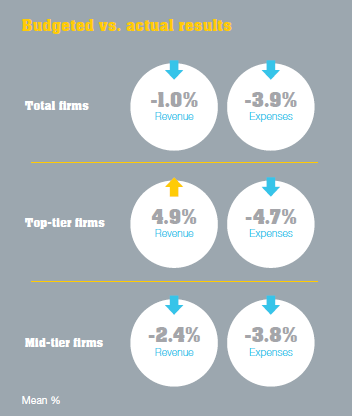
I’ll most likely review the findings of this report more closely in a post later this week – and it may even be interesting to compare them against previous Q2  & Q3 reports – but for the purposes of this post I believe we don’t really need to go past the following infographic from the report:
CBA Q42014 Graph

which would certainly seem to indicate that “top-tier” firms are far happier with overall FY2014 results than their “mid-tier” cousins.

Bringing it all together

So, what does this mean?

To my mind what these three reports cumulatively evidence is this:- while #NewLaw may have arrived, and while it may be here to stay, what is increasingly clear is that #BigLaw is not the market segment that needs to be concerned with this development.

Nope, dig a little deeper and I think you’ll find that it is actually Managing Partners in firms with revenue in the A$20-A$70 million range who will be having a lot more restless nights sleep…

“You actually need to be in Asia to understand Asia.”

Business Development image

“You actually need to be in Asia to understand Asia. You cannot look at it from a distance, or certainly run a business in Asia from a distance. So, unless you are actually in Asia and focused on Asia and the different markets in Asia, it’s very difficult to understand the different markets, their stages of development, and how you need to run your business in those markets. And certainly you can’t do that from London or New York. That’s a fundamental point.” – Stuart Fuller, King & Wood Mallesons

The above quote, which I couldn’t have put better myself, is from an interesting interview between columnist David Parnell and Stuart Fuller, Global Managing Partner of King & Wood Mallesons (‘Stuart Fuller Of King & Wood Mallesons, On Vereins and Succeeding in China’s Legal Market‘) posted to the Forbes website on 20 July 2015.

A lot can be said about the ‘Mallesons’ strategic approach to Asia (or, probably more to the point, the lack of it) in its days as ‘Mallesons Stephen Jaques’ – when the firm was rumoured to be heavily courted by the likes of Clifford Chance and Linklaters in the UK – but since the tie-up with King & Wood (and the subsequent merger with SJ Berwin), the firm that is KWM, as it is now affectionately known, has certainly turned a corner, got its strategy ducks lined up and come a long way.

To my mind evidence of this is clear in the following two paragraphs by Fuller:

“Secondly, it’s a business model issue. If you come into Asia and run a Western business model, then you are likely to lose money. That’s quite difficult for many of the international firms because they have such powerful and strong business models in their home markets, and they export them to the rest of the world.

Thirdly, some markets are more developed than others, so if you come into Asia and think that because the law firms are younger, that they are less developed, or frankly, in some ways less professional, then you’ll be surprised. There are firms here — us for instance — who have 1200 lawyers and 2000 people across 12 cities in China alone. We have an impressive international business in China operating at an international standard. There are a number of firms across the market like us, and I think that is a surprise to Westerners.”

Absolutely spot on!

Indeed, probably the only thing missing from Fuller is the strength that relationships play in the overall marketplace throughout Asia – both at government level and in many of the region’s family run businesses.

Then again, possibly that’s what Fuller is eluding to when he says:

“And for Western business coming into Asia, the big thing you need to know is how to get things done. The system is different. It’s the lore as much as the law.”

In any event, it is clear that KWM has moved forward a long way since 2012, and I’m not sure the rest of the pack are giving this firm the appropriate credit they deserve.

In 2015 the challenge we face is ourselves

Business Development image

Happy New Year to you all.

At this time of year you’ll likely read your fair share of articles predicting what the year ahead will bring. You may even read the odd article or two on the trends that are likely to impact on our business during the course of this year.

I should state for the record that I enjoy reading these articles and in many cases the predictions are not too far off the mark.

Indeed,  in previous years I would have been one of the first to gaze into my crystal ball and give you my prediction on the 10 or so issues that we are most likely going to face in 2015.

But not so this year.

To my mind the biggest challenge we, as business developers, face in 2015 is the fact that our business development efforts have been missing their mark in recent years.

To be clear, this is not a message I’m sending out there as a business developer.

I wish.

No, this is something our clients are telling us loud and clear.

In short, we, as business developers, have not been listening to what our pay masters are telling us.

Crucially, in 2015 we are also likely to see our marketing and business development messages lost in the noise surrounding chatter around AEC, ASEAN (as the region decides whether 2015 really is the year) and other such regional and global initiatives (Free Trade Zones being one).

While each of these will undoubtably be important factors for our business over the next 12 months, it is my belief that none is likely to lead to our down fall.

For the answer to that question, again we only need look at the resounding message being sent to us by our clients (yes, our clients), over a prolonged period now:

business development activities by law firm [in Asia] in 2014 missed their mark.

In 2015 then, we business developers need to be lifting our game and constantly asking:

what can we, as a law firm, be doing differently that will help our clients win more work, generate more revenue, and earn them higher rates of profitable return?

Alternatively, carry on as normal in 2015 and don’t be surprised if, at year-end, this is the result:

“If you always do what you’ve always done, you’ll always get what you’ve always got.”

-Henry Ford