As I tidy up my work desk before going into an unknown period of working from home I am reminded of the following Steve Jobs quote:

Here’s to hoping the crazy one’s help steer us back to something like normal life soon…
As I tidy up my work desk before going into an unknown period of working from home I am reminded of the following Steve Jobs quote:
Here’s to hoping the crazy one’s help steer us back to something like normal life soon…
Recently I was listening to an encore episode of Season 2 of Scott McKain’s Project Distinct podcast on how to analysis your current client situation. In the podcast Scott suggests applying what he calls his ‘cub reporter’ questions to any stress test you undertake on the strength of your current client relationship, by asking:
Applying Scott’s approach to law firm client relations has me asking some of the following foundation questions:
Hopefully a useful starting list and if you have not previously listened to Scott’s Project Distinct – a daily podcast that runs for a relatively short 10 minutes, I would like to strongly suggest you do.
Back in the mid 1990s, when I was first starting out in this profession we call “law”, I was putting my jacket on to go home. As I recall it was around 8.30 p.m., after what had been a long day. The partner I was working for at the time saw what I was doing and asked me:
“Are you cold?”
In an era when if a partner asked you to jump, you replied “how high?” – I got the message.
I sat down and got back to work.
Fast forward to today’s world
So why does this old war story from the trenches even matter in today’s world?
This story matters because of some press coverage here in Australia following recent investigations, etc, by Australia’s Fair Work Commission (FWC). The upshot of this (as I understand it, and I could be wrong) is that the FWC, rather ironically if you ask me, is looking at the number of hours junior lawyers are working to ensure they are being paid minimum wage.
As is often the case when the business of law model is under attack, the establishment fights back. In recent press coverage here in Australia this has included comments in the following two articles in the Australian Financial Review:
Long hours aren’t just for young lawyers in which John Denton (ex-CEO of Corrs) argues that:
Welcome to the real world, law grads in which John Roskam (an executive director of the Institute of Public Affairs, a conservative think tank based in Melbourne, Australia – and so far as I can tell has never been a lawyer) basically says that if you don’t like being a hard working law grad or junior lawyer, then nobody is making you do it and go and go join the world of commerce where they work much harder (for the record, in my day it was the dot.com world).
So let’s put this into a little context for a second:
All of which has me wanting to say:
And I’ll leave you with this: In case you are left wondering, it has been a long held view of mine that billable hour targets are unhealthy and a really crappy way of working out law firm revenue budgets (side joke for the nerdy, every time someone leaves your team you have to budget re-forecast!).
I once wrote a long blog post predicting what would happen in the year ahead (‘10 things that could happen in the Australian legal market in 2013‘). It was a train-wreck (many of these ‘future’ looking predictions we are still waiting to see 7 years later!) and I promised I would never do it again.
But I recently listened to a podcast about the role of AI and the future of “back office support” (a term I prefer to call Allied Professionals) [hint: we are all doomed to automation] in the legal industry that has promoted me to break my 7 year rule and make this bold prediction:
More allied professional jobs (Secretaries, HR, Marketing, Business Development, Finance etc) will be lost in the next 5 years to both on and off-shore outsourcing than will be lost to IA and innovation.
Now remember that my track-record is rubbish; so always interested to hear your thoughts/views/feedback.
Last week the Center on Ethics and the Legal Profession at the Georgetown University Law Center and Thomson Reuters Legal Executive Institute and Peer Monitor published their ‘2020 Report on the State of the Legal Market‘. This annual Report sets out the publishers’ views of the dominant trends impacting the legal market in the United States in 2019 and the key issues likely to influence the market in 2020 and beyond.
The Introduction of this year’s Report looks at ‘Incremental Improvement vs. Radical Change‘, as it might apply to the current state of the legal industry.
Drawing on the story of Dick Fosbury’s performance at the Mexico City Olympics in 1968, at which Fosbury stunned the world by setting a new Olympic record in the men’s high-jump event using a technique (the Fosbury flop) that had never been used in competition anywhere else previously, the Introduction to this year’s Report sets a great – and somewhat dramatic – backdrop to what it considers constitutes radical change against incremental change.
The Fosbury flop, without doubt, was radical change to a long held practice in 1968. But, post 1976, when all three medallist used the technique, it can also claim to be the victim of incremental improvement/change, as there hasn’t really been any great leap forward in high jump technique since.
So what has this all to do with the legal industry?
Well, it’s like this, probably since the mid-1980s the legal industry has undergone a series of incremental improvements, without really being the subject of any radical change. But, as the Report eludes, the last 12 to 18 months in the legal industry may have seen a shift here. The re-emergence of the Big 4, growth of legal tech, alternative legal service providers suggest a cusp of radical change is on the horizon (if it hasn’t already arrived).
So has it?
Well, I’m not so sure. Let’s take a look at some of the graphics in the report:
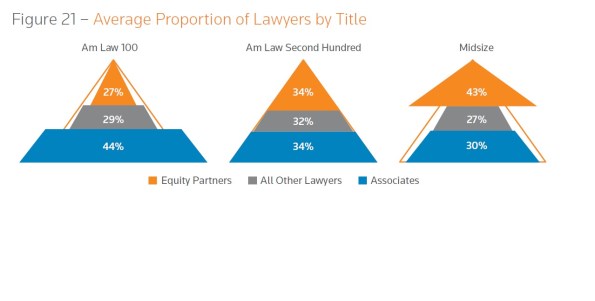
The graphic above looks at leverage of lawyers in US firms. Aside from the ‘Midsize’ firms, where a type of diamond is forming, the AM Law 100 and 200 look like very traditional law firm pyramids to me.
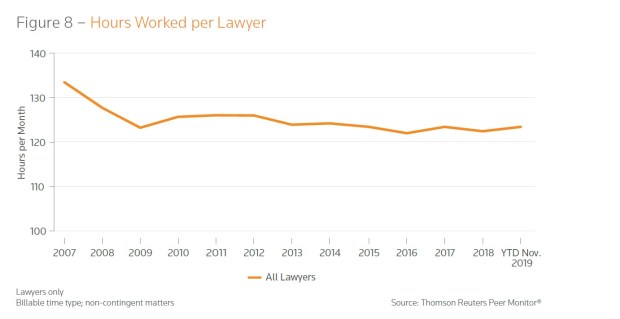 This second graph looks numbers of hours worked per lawyer and this looks to have flat-lined since the GFC in 2008. So no real change there.
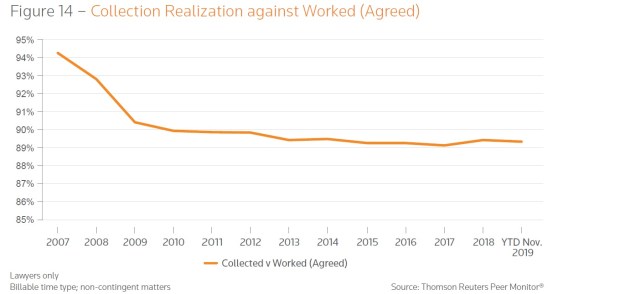 This third – and last – graphic looks at collection realization against agreed worked and, again, has pretty much flat-lined over the past 5 years at a relatively horrid 89.5%.
Collectively these three graphics paint a rather sad story to me. There may be change in the industry. But it is far from radical. And one may argue it really hasn’t even been that incremental post 2008; with the caveat that you also need to be mindful that not all industry segments are now equal, as some are clearly more equal that others!
As always though, read the Report as I’d be interested in your thoughts/views/feedback.
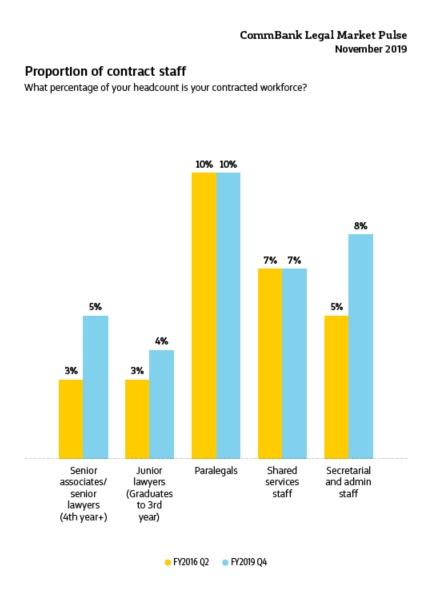
We have seen a rise in the use of contractors in more senior legal practitioner roles in recent years. This has been supported by firms moving to introduce their own contract legal businesses to manage fluctuations in workflow.”
Marc Totaro – National Manager, Professional Services Business & Private Banking; Commonwealth Bank of Australia
Earlier this month the Commonwealth Bank published the 2019 edition of its Legal Market Pulse. While the Report relates specifically to law firms and the legal industry in Australia, it contains a number of take-outs and trends that I believe can be applied more broadly across the global industry that is ‘legal services’.
One of these, as the quote from Marc Totaro above indicates, is the documented rise in the Report in the use of contractors within law firms themselves.
Until recently I had not seen much traction with suppliers of legally qualified contractors cracking the private practice market. Don’t get me wrong, I knew who Crowd & Co were and I had read about the arrangement between Lawyers on Demand and DLA Piper. But the actual use of contractors to back-stop in private practice hadn’t really registered with me. Part of the reason for my scepticism here had been centred around the issue of:
Why would law firms with relatively poor utilisation rates want or need the use of contractors?
My thinking here changed though following a conversation I had with Katherine Thomas, CEO of Free Range Lawyers and ex-Vario (Pinsent Masons). Katherine assured me – and convinced me – that the tide was changing and that law firms were now making use of access to highly skilled contractors for both locums and projects as part of their core HR strategy. And when I got to thinking about it a little more I realised that poor utilisation rates would actually be a really good reason why you would want to have access to contractors at it would give you greater flexibility in managing your teams’ resourcing.
In any event, the Commbank Report would appear to provide anecdotal evidence to Katherine’s views in that law firms are indeed making greater use of contractors. What’s probably more encouraging – from Katherine’s financial point of view – though is the fact that biggest area of year-on-year increase in usage is at the Senior Associate/Senior Lawyer (4+ years) level.
And in my view, the contractor trend is probably one of the biggest insights to come out of this Report – although others are writing a lot more around others things contain in the Report so make sure you read it!
Now if only I had been smart enough to read that market trend!
As always though, interested in your thoughts/views/feedback.
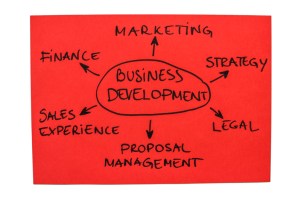
This blog post is based on a #2020futureoflawthought I posted last week on social media – ‘Who pays you better, the client you attract or the client you pursue?’.
It occurs to me that law firms are much more willing – and even better resourced – to pursue customers than they are to attract them. We have dedicated pursue customer resources to hand – such as bids, tenders and pursuits teams. And we are willing to offer discounts and other ‘value adds’ to new customers that we would never think of offering to existing and loyal customers.
And what do we get for throwing all these resources and efforts in to pursuing customers?
If we are honest, and have a really good bid/tender/pursuit team to call on, somewhere between 50%-70% win conversion rate! Which is not to say that conversion rate is profitable, because in many cases to get us across the line it isn’t!
Create distinction
Recently I started listening to Scott McKain’s daily ‘Project Distinction‘ podcast. It’s a great podcast that lasts around 10 minutes; around the same time as I made my social media post, Scott ran a week long series on how the ‘hard sell’ had had its day (the $55 million dollar ‘lost’ sale is a funny listen and a serious lesson in to why the 7 touches sales method is dead IMO).
Scott is also the author of ‘Create Distinction’, a book I have just started reading on the back of his daily podcasts that I have really enjoyed.
Anyhow, both Scott’s podcast and what I have read of his book so far have made me come to the realisation that the traditional law firm approach of pursuing a customer is actually the wrong way of doing things. Instead of pursuing customers with great value adds and discounts, we need to get much better at attracting customers – to our areas of expertise and to our superior service delivery.
Become a person of interest
Timely Andrew Sobel – one of the greats in my opinion – also touched on the issue of attracting versus pursuing customers in his blog post last week: ‘C-Suite Strategies Part IV: Become an Irresistible Person of Interest’.
In the post Andrew asks:
What if, however, the situation were reversed, and senior executives were *drawn to you*? What if, instead of you waiting in the long line outside their office, they were waiting in a line to meet *you*?
Fair question: what indeed?
Andrew then sets out six ‘strategies’ (more like ‘tips’ in my opinion) on how to become a person of interest, that include:
Something to think about this week then: would you prefer to be attracting or pursuing customers?
As always though, interested in your thoughts/views/feedback.
I first came across the use of “personas”, in the buying-cycle, in ‘This is Service Design Doing’ by Marc Stinkdorn, Edgar Hormess, Markus, Adam Lawrence, and Jakob Schneider. This is one of those books that have a pivotal impact on your thinking and go directly into your Top 20 reading recommendations.
But it has been a while since I last picked the book up. And so when I was reading ‘Personas – A Simple Introduction’ by Rikke Dam and Two Siang this week (as material for this week‘s newsletter) it brought me immediately back to Service Design Doing; especially, or probably more particularly, who Dam and Siang define “persona” as being:
Personas are fictional characters, which you create based upon your research in order to represent the different user types that might use your service, product, site, or brand in a similar way. Creating personas will help you to understand your users’ needs, experiences, behaviours and goals. Creating personas can help you step out of yourself. It can help you to recognise that different people have different needs and expectations, and it can also help you to identify with the user you’re designing for.
How many law firm business development / tender / pitch / pursuit / etc professionals use this concept in their bid/no bid process? Not many would be my guess.
But think of the benefits of your law firm role playing (or at least giving a chair to) the following personas in any tender “bid/no bid” discussion:
And the list can go on and on.
If your firm played this game, do you think you might start to get a little better at wining tenders?
As always though, interested in your thoughts/views/feedback.
I’ve long been a fan of Ron Baker’s ‘Baker’s Law: Bad Customers Drive Out Good Customers’. His comment that:
By viewing your firm as an airplane with a fixed amount of seats, you will begin to adapt your capacity to those customers who appreciate—and are willing to pay for—your value proposition.
is spot on.
But it really wasn’t until last week, when I read an article in smallbiztrends.com, that I’d come across a comprehensive checklist of ways to identify those bad customers from the good ones.
The article – ‘How to Spot Bad Customers – and How to Deal with Them’ – sets out ’10 Ways to Identify a Bad Customer’. They’re great and should be pinned on every lawyers homepage:
How many of us can identify with most, if not all of these!?!?
It’s a great post. As is Baker’s. Read them (while noting that there is a 13 year gap between the two posts and not a lot has changed!)!
As always though, interested in your thoughts/views/feedback.
I want to start this post by acknowledging how far the discussion around mental health and wellbeing has moved within the Australia legal industry since the death of Tristan Jespon in October 2004. In part I put the moving of this needle down to the work of my good friend Justin Whealing while he was editor of Lawyers Weekly and in part I put this down to the continued work of Jerome Doraisamy, also of Lawyers Weekly and Minds Count (the new name for The Tristan Jepson Memorial Foundation). Don’t get me wrong though, there are many many others who have played both active front-line and support roles in ensuring the issue of mental health and wellbeing is taken more seriously in our profession (see RUOKAY Day for example).
That said, while I think all of these initiatives and discussions are fantastic and are standouts that should make us extremely proud of the direction the industry is taking in Australia, almost every single conversation that I have been involved in on this issue has related to the mental health and wellbeing of lawyers – and, more specifically, junior lawyers. So it was great to see a report published earlier this month by fSquared Marketing on the issue of ‘Legal Marketing Mental Wellness’.
The subtitle of this report – ‘Stress in legal affects more than just lawyers’ – sets out the parameters of the journey the reader is about to undertake. And if you are left in any doubt about this, one of the first paragraphs of the Report cuts to the rub of the issue and totally grabs your attention and is also so very true.
It reads:
What about the legal marketing and business development professionals who are tasked with growing firms how is their mental health? They work in the same high-pressure environment as attorneys after all, and often under their direct management. Might the traditional pyramid structure, with equity partners at the peak, lead to stress cascading down the hierarchy to fall on the shoulders of the marketing and BD staff?
As someone who has worked on the front-line for over a decade my response is – ABSOLUTELY!
Taking a look at some of the responses I was particularly saddened, although not overly surprised, by these two graphs:
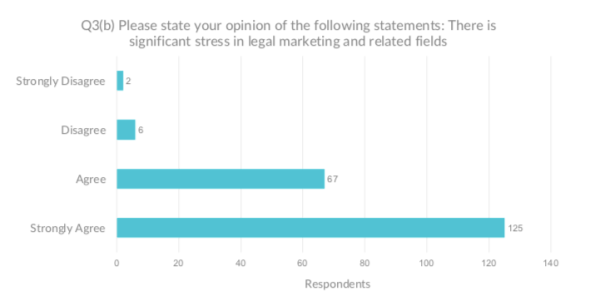
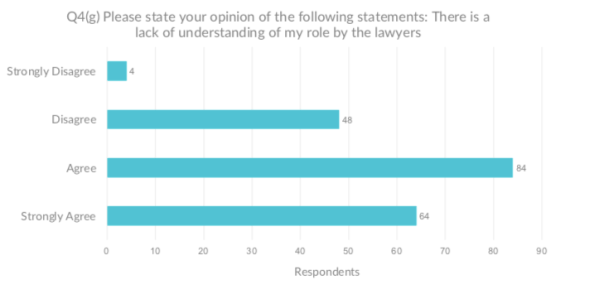
both of which were followed up by:
And the following two highlighted comments made me sad that I personally am not delivering on my duty to my team and that the industry more generally really needs to address this issue:
“Much of the stress would be alleviated with stronger leadership from firm management, as well as from growing the marketing/business development team.”
“It is unfortunate that law firms segregate mental health awareness between lawyers and non-lawyers. Somehow they feel that staff (with whom they work directly) do not suffer from the same level of stress that the lawyers do.”
As damning as that last statement is – and never underestimate how damning it is, I want to end this post on a positive note, and that is this:
62% agreed or strongly agreed with the statement: “My team’s ‘wins’ in marketing are celebrated”.
I certainly hope my wonderful team think so!
*if you are having issues in this area, no matter what firm you are from, never feel shy to reach out. I don’t promise to have the answer (frankly I won’t), but I will try and help you find that answer.
 RWS_01's B[D]log