General business development issues

What does ‘being responsive’ mean to your law firm?

Ask nearly every lawyer you know whether or not they are “responsive” and to a T they will say “yes”. Most will likely back this up by saying they respond to emails within 24 hours and phone calls within 3 hours. Great stuff, but very reactive.

But does how a law firm see ‘being responsive’ equate with how in-house lawyers view their law firms ‘being responsive’? More importantly, can a law firm be proactively responsive?

A partial answer to this question was provided by Bupa’s legal chief Penny Dudley in an interview she gave to Legal Week yesterday (4 March 2017) – Bupa legal chief Penny Dudley on stepping up, what she looks for in a law firm and Brexit challenges -when asked the question:

What do you look for in an external adviser?

she replied, in part…

…I am obviously very keen on a firm’s responsiveness; even up to the point of anticipating things for us.

Wait, “anticipating things” for you – that’s not responsive! Or, is it…?

rws_01

Can a law firm ‘own’ a client?

If you were not already aware of it, a train wreck is currently taking place in the Australian legal sector:- the partners of Herbert Smith Freehills (HSF) are suing the departing partner leaving to set-up White & Case’s new Australian venture and nasty details of this divorce are being spread all over the Australian Financial Review on a weekly (sometimes daily) basis.

From yesterday‘s (Monday 3 April 2017) instalment we learnt that the departing partners collectively spent $364,000 on business development activities in the financial year 2016* on such things as:

  • trips to the exclusive Barnbougle golf course in Tasmania,
  • an $800 bottle of wine for a general manager of one of Australia’s leading energy companies (who is most likely hiding out in his/her office ruing the day they ever heard of HSF), and
  • getting in on the next generation, gifts for the births of clients’ babies.

The most interesting part of yesterday’s nugget wasn’t, however, all the unscrupulous details of what the partners at HSF call ‘business development’; but, rather the news that HSF are claiming that as they spent the money on the BD activities, and not the departing partners themselves directly, the client actually ‘belongs’ to the firm – and, therefore, the partners are ‘not allowed’ to take the client with them to White & Case.

Wow, hold on there for a second.

Leaving aside the fact that most of the clients who have been named and shamed for several weeks in one of Australia’s leading business publications and whose wining and dining (literally) has been described in miniature detail in court papers are unlikely to want to go anywhere near either firm for the foreseeable future, with the level of lateral hiring that has taken place in the Australian legal market over the last few years, arguing that because the firm has paid the business development dollars the firm owns the client raises a very interesting and thorny issue for the courts.

The next round in these hostilities is due to take place June 5, but I await the outcome of whether or not a firm can ‘own’ a client with interest. Because if the result goes one way, it may just kill the lateral hiring market overnight.

rws_01

*  poor Ms Draper must be wondering what she has done wrong too, having only ‘spent’ $2,865 on business development activities during that period but being pulled to the confession box along with all the other naughty sinners

Deutsche Bank, junior lawyers, being outcome focused, and a voice of reason

A fair amount has been written since Legal Week published its story on 21 March that ‘Deutsche Bank to refuse to pay for trainees and NQ lawyers after panel overhaul‘, which alleged that the Bank had told its panel firms it would no longer pay for trainee and NQ lawyer time on its files. Some of the commentary around this story has been in favour of the Bank’s position, some has questioned the wisdom of the Bank, and the vast majority of it has sat somewhere in the middle*.

With the level of public legal issues the Bank has had in the past few years, it’s little wonder that the Bank would look to reduce its legal fees, and not paying for trainees’ and NQ Lawyers’ time would certainly go some way to achieving that goal.

That’s all well and good, but to my mind if you are outcome orientated – rather than input driven – then the number of years a person has done something really doesn’t bother you – because what you are really paying for is the result. I mean: who is to know who will have that eureka moment?!?

Sure, it may be more likely to happen to a more experienced lawyer. But isn’t it just as likely that a senior lawyer will have their thinking clouded and the answer comes in the form of a fresh eyes approach from a junior lawyer?

And so enter a voice of reason into the debate – in the form of Vodafone Enterprise global general counsel Kerry Phillip, who is quoted in a later Legal Week article on the issue as saying:

“We do not expect to be charged for training time, but not everything a trainee does is training time. Law firms should absorb the cost of training solicitors, but where there is genuine value added to the client – rather than pure learning through shadowing or watching – then it is fair to charge.”

Absolutely spot on Ms Phillip.

But, crucially, this concept can be extended to all lawyers who act on all matters, in that where you genuinely add value to your client’s business/issue, then charge for it and more often than not you’ll be paid for it (without questioning of the bill).

But, where you don’t add value to your client’s business or issue, you cannot charge for it. Or, more accurately, you can: but increasingly you won’t be paid for it.

And just for the record, Ms Phillip goes on to say in that article:

“That said, we generally agree a fixed price for a piece of work. I expect the law firm to put an appropriately experienced and qualified person on that work, but we are paying for an agreed result or output that the firm puts its name to.”

Again, absolutely spot on:- clients are paying for an agreed result or output that your firm puts its name to – and there is a massive, massive, marketing lesson for private practice law firms to get their heads around in that statement.

rws_01

* NB: in my experience working tenders, Australia has seen this trend since at least 2010 – if not before.

Anyone know what’s going on at LinkedIn?

julian-li4-copy

(Julian Summerhayes update posted this week to LinkedIn)

I’ve just returned from paternity leave to turn on my computer and find that LinkedIn has undergone yet another ‘upgrade’ in my absence.

Before I left I was giving very serious thought to moving away from blogging here on WordPress and doing more (or, for that matter, my first) posts to LinkedIn directly.

Undoubtedly the publishing platform was growing in popularity among those I respect – including my good friend Julian Summerhayes (who inspired this post) – and an ever increasing number of posts in my weekly newsletter were being published directly to LinkedIn (as opposed to republished, which was very common about a year ago).

It all made sense. Then.

With the ‘upgrade’, that’s all changed.

Why?

Because I hate this latest, so-called, ‘upgrade’.

Some of the things that have immediately off-sided me (and I have yet to have a proper look under the bonnet so to speak) with this latest upgrade include having to go to a separate widget if I want to view or post to my Group, not being able to see updates in real time, and being dependent on LinkedIn’s algorithms to read my preferences (it doesn’t).

In the real scheme of things these changes are not material or major. LinkedIn will survive the fallout.

More importantly what it shows me is this:-

LinkedIn has had a concerted and somewhat successful strategy of late to move itself away from being a modern form of CRM database to becoming a major player in the online world of content aggregation and publishing.

With these ‘upgrades’, in my opinion this strategy is dead in the water.

Linekedin is, once again, little more than an address book.

rws_01


Another reason why law firms will never be considered innovative

Business Development image

Almost four years ago (5 March 2013), when I was blogging on a different platform (Australian law firm business development), I blogged that ‘Australian law firm offices to face foreign currency exchange woes?‘. In that post I stated that:

The importance of this [currency exchange fluctuations] becomes clear when you realise that Australian law offices who report back to an overseas head office could, in effect, have a numerical “loss” or “fall in revenue” of 10 to 20 per cent or more, without there being any real decrease in their domestic revenue/profit.

Worse, in order to keep their fellow partners happy in London, New York or Chicago, Australian-based partners will need to drastically increase their local revenue and profit without having the pleasure of their being credited with this on an international level! And keep in mind that all of this is taking place at a time when the market is becoming more competitive on a daily basis.

All I can say to that is – “best of luck”. Alternatively, maybe now is the time to call your bankers and to start getting involved in foreign exchange currency swap arrangements.

Bold and underline by me for emphasis.

Now why would I bring up a post I made almost 4 years ago?

Because, last week The American Lawyer reported: ‘As Currencies Suffer, Law Firms Try Hedging to Safeguard Revenues‘ in which they state:

To mitigate the uncertainty that comes with earning revenue in varied currencies, some law firms have started hedging currency, a practice that is more common among big multinational companies.

Overall revenue suffers when one or more of the currencies that make a firm’s revenue declines against the dollar, while pay discrepancies between partners in different countries widen if the foreign based-partners are paid in local currency.

So almost four years to the day after I suggested this, I’d now like to ask these same firms to read a post of mine from three years ago. It offers up some advice on another tactic they may want to consider.

rws_01


Move over LPM, 2017 will be the year of LPM

Business Development image

For some time now the bigger law firms have positioned and prompted their use of legal project management (LPM) in the carriage of their client matters. Initially a little sceptical of the benefits of the application of LPM, most clients now demand some sort of project plan prior to the commencement of matters. Like other developments however, it’s use varies according to the type of matter, its complexity and the practice group doing the work.

Some may say that the use of LPM has come leaps and bounds in the past decade. My own view is far more sceptical.

Why? – well, in part, because I trained as a major projects/PFI lawyer in the mid-1990s and almost every office (in the days before open plan offices) had either a white board or chalk board with the deal plan set out on it (with critical project dates). Almost all the lawyers I knew in those days practised LPM, we just didn’t call it that.

That said and out the way, I want to introduce you to the LPM that will probably have a massive impact on how we resource legal matters going forward.

Legal Portfolio Management.

The ‘portfolio’ here relates to numerous rising trends.

It can mean ‘unbundling’ – where their is a split between what in-house lawyers and their private practice lawyers agree to do.

It can mean how private practice firms resource their matters – moving away from utilisation rates as a performance indicator – where one person doing 200% and another 50%  is a matric of success – to one where ‘team’ means meeting the lows and highs of resourcing around the firm (although I will add this will likely need the use of practice or client managers taking charge of the issue rather than client relationship managers).

Importantly, and increasingly, it will mean ‘agile’ working. By ‘agile’ here I refer to the use of freelancers/contractors/locum (see Lawyers On Demand and Crowd and Co) to met capacity needs, to the use of in-house shared services (see Westpac and Telstra), to the use of teams comprising lawyers from different law firms.

Whatever else, it is my view that Legal Portfolio Management will have significantly more impact on the long term resourcing of legal matters than LPM has.

And, probably for the first time, the opening two lines of the most recent (January – March 2017) Hays Trends Report for Legal In-house validates my thinking:
“Temporary and contract opportunities continue to arise as a result of new projects that existing teams do not have the capacity to undertake”.
Mark those words, for they foretell a movement coming your way!

The perfect storm for #OldLaw?

In my last post I mentioned that I may post some further thought I had on this year’s Altman Weil Chief Legal Officer Survey.

One further comment on the Survey findings I did want to make relates to what I consider to be ‘the perfect storm’ brewing for the so-called #OldLaw or Traditional Law firm model.

And the best thing about this post is that my point can be made by showing you the following three easy to read charts from the Survey:

Chart 1

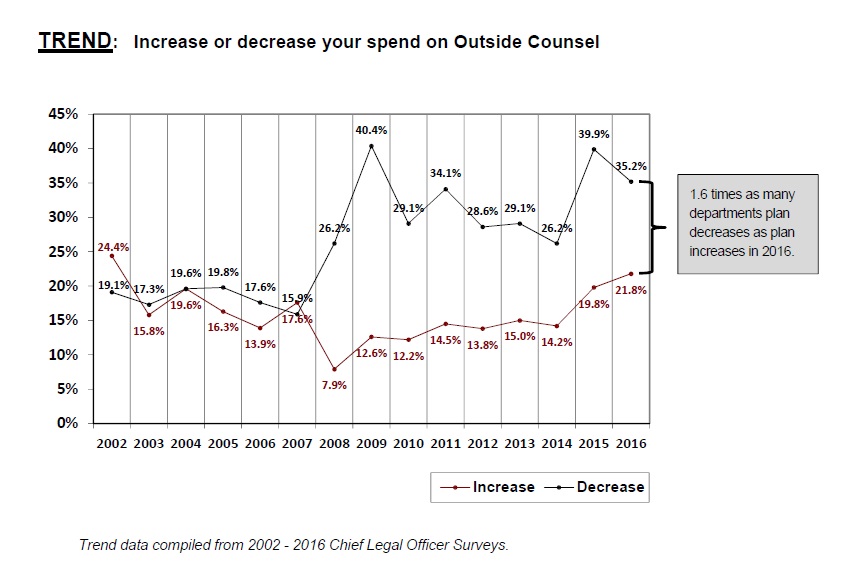
QUESTION: What are the chances you’ll be spending more money with me – your outside counsel – in the medium to long-term?

aw-1

[click on chart to expand]

ANSWER: Not an awful lot!

Chart 2

QUESTION: If you are not giving me – your outside counsel – the work, then who are you giving it to (ie, who is my main competitor)?


aw2

[click on chart to expand]

ANSWER: Yourself!

Chart 3

QUESTION: When you do give me work, what are the chances that you are going to ask me for a discount?

aw3

[click on chart to expand]

ANSWER: Very likely indeed!

Have to say, reading these three charts I’m left with the feeling that outside counsel are in for a very rough ride unless they are 100% focussed on what they want to do, and who they want to do it for!

RWS_01

The BIG takeout from this year’s Altman Weil CLO Survey

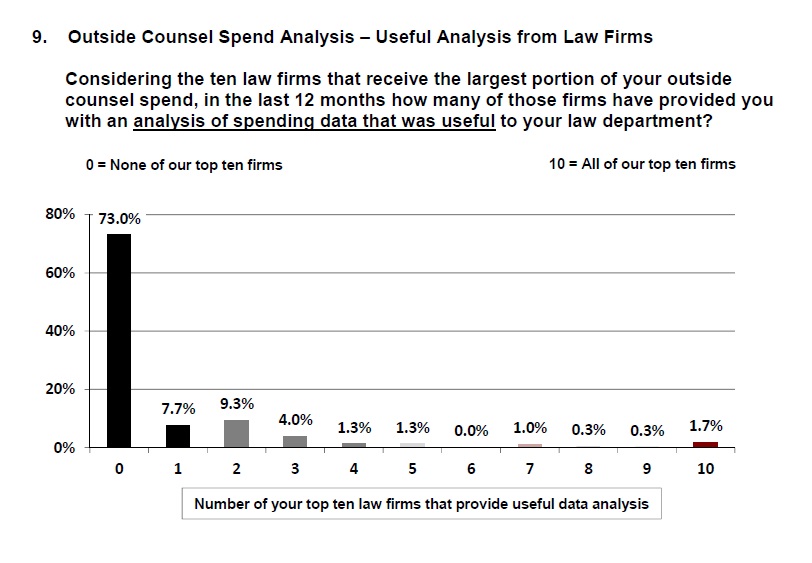
Altman Weil published the 2016 edition of its Chief Legal Officer Survey overnight Australian time. I may well post some more of my thoughts on this year’s content in the coming days, but what I wanted to share with you immediately is what I consider to be one of the most damning charts I have ever seen as it relates to business development, legal spend, and client relationship management:

altman-weil-clo-survey

That’s right, when asked the question:

Considering the ten law firms that receive the largest portion of your outside counsel spend, in the last 12 months how many of those firms have provided you with an analysis of spending data that was useful to your law department?

An overwhelming majority of CLOs (73%) responded “none”.

So, if you work for a law firm looking to differentiate your services; then the answer is it really isn’t that difficult.

RWS_01

The R.U.L.E.S revisited

In August 2013 I posted ‘Is it time for law firms to break with the RULES when looking at profitability?‘ on my old blog platform Australian law firm business development. It is without doubt the most read post I’ve ever written. And, as the recent publicity around DLA Piper’s decision to make equity partners clock 7.5 hours a day of time (not necessarily billed) shows, it remains one of the least followed and understood.

So what is the “R.U.L.E.S” system – and, three years after I last posted on this: do we, once again, need to promote its demise?

The R.U.L.E.S.

Taken from Robert J Arndt’s relatively short (at 31 pages) 1988 publication ‘Identifying profits (or losses) in the law firm‘, the acronym R.U.L.E.S stands for:

  • Realization – of billing rates
  • Utilization – of attorneys
  • Leverage – of lawyers
  • Expense – control of (both the fixed and variable kind), and
  • Speed – of the firm’s billings and collections.

For more than two decades the R.U.L.E.S have been the foundation for law firms looking to mine their financial information beyond the mere top level question of: ‘Did the firm made any money this year?’. Indeed, it could be argued that they were the precursor to the Balanced Scorecard in that they help determine:

  • which lawyers and partners are making a profit,
  • which practice areas are making a profit,
  • which matters are more profitable than others, and
  • which clients are more profitable than others.

But, in today’s world the R.U.L.E.S are not without fault. For example,

  • Realization is generally accepted as being the amount collected (ie, in the bank) against the effort to produce (ie productivity); or, as Altman Weil defines it: “realization is fees collected divided by the standard value of the time worked“.

On an individual fee earner basis, what this means is that if you set your fee earner a standard billable hourly rack-rate of [say] $100, and they charge the client $90 per hour (after write-offs etc) for work done, and for which the client pays $85 per hour (after asking for a discount etc) for the work, then the realization rate is 85% [I note that some firms adopt the practice of looking at realization as being the amount paid against the amount billed (94.44% in this example) but this is not the methodology used in RULES].

On the other hand, if the same fee earner does a fixed fee job for $1,000 and it only takes them 5 hours to do the job (cost of $500), then the realized rate is $200%.

While this may have been a good indicator of individual lawyers’ profitability in the past, increasingly it isn’t – not least because clients see through this BS and will not pay for their lawyers on a fully rack-rated hourly basis.

  • Utilization is the yardstick by which we determine how busy fee earners are. To determine this we look at the annual budget of hours the firm has set each relevant fee earner against the amount of billable time they have put on their time-sheets (daily, weekly, monthly or annually).

As I mentioned in 2013 – and nothing has changed – there are two principal flaws with this use of utilization:

  • the first, as shown by the likes of Crowell & Moring and others, is that the annual billable hour figure is a moving goal post.
  • the second, and more important, reason is that utilization sees an hour billed as “king” – it trumps all.

Today, where clients are looking for, among other things, an understanding of their business (non-billable hours spent attending industry events) and corporate social responsibility, utilization seems an outdated profit related performance metric.

  • Leverage is the number of fee earners you have to partners.

A reading of Maister’s Managing the Professional Service Firm will tell you, leverage is a key component of a law firm’s profitability. In order for a law firm to be more profitable, the maximum amount of work possible must be pushed down the chain to the more junior ranking lawyers.

Unfortunately, today this cannot be done so easily. Clients are simply not willing to pay for you to train your junior fee earners!

  • Expenses are both fixed (ie rent) and variable (ie salaries and bonuses) and are always going to be an important factor in determining a law firm’s profitability.
  • Speed of collection is generally determined as being the time from when you did the work to the time you are paid for that work.

Sometimes known as “lock-up” days, speed of collection will have a massive effect on the firm’s profitability.

Having bagged the R.U.L.E.S – again, the question remains: ‘What are the alternatives?’ The answer to that is that there are probably far more now than there were three years ago, but they are start from the same place:

(a) Do you have a satisfied client, and (b) Do you understand the value you bring to that relationship?

RWS_01

Is it better to focus on ‘Service Outcomes’ or ‘Labour Inputs’?

Business Development image

A lot has already been written about DLA Piper’s rumoured requirement that its equity partners document 7.5 hours of work a day. Referred to as the ‘Red Card‘ system, this latest initiative by DLA is reportedly being put in place by its COO Andrew Darwin in order to reduce/eliminate ‘delinquent behaviour‘ by withholding quarterly profit drawings and, if persistent, reduced monthly drawings of those partners who do not meet the 7.5 hours a day target.

Now, as has been noted elsewhere, this 7.5 hours a day doesn’t have to be billable work – it merely needs to be ‘documented’. As such, marketing, administration, mentoring, and knowledge management tasks can all count towards this daily target.

But I have two questions for those like legal recruiter Dan Binstock, co-chair of Garrison & Sisson’s Partner and Practice Group Division, who suggest that:

“[A] policy like this is usually brought on due to unproductive behavior that needs to be addressed. While this is unusual, if there are segments of partners who are not carrying their own weight and coasting, this policy is definitively a firm kick in the rear.”
Which are:
  1. Do labour inputs reflect service outcomes?
  2. Do labour inputs reflect productive time?

Now I will accept that if you are answering the above two questions in a modern law firm -ie, exceeding budget – then it is highly likely you are far exceeding the 7.5 hours a day requirement.

So here’s the thing: I’m sure Andrew Darwin’s latest initiative has an agenda. Like others have written, I’m sure it has more to do with forcing unproductive partners of the firm out than it has to do with rewarding partners who exceed the requirement. It’s only a shame that in a global partnership, behaviours among equity partners is such that if an equity partner (yes, “equity”) is unproductive, has been given every opportunity to rectify this and turn things around, and has not done so, they can no longer be tapped on the shoulder and asked to move on.

RWS_01