Author: RWS_01

Over 20 years’ experience developing and implementing effective business development strategies in law firms across Australia and Asia.

How much are internal meeting costing you? – Set a zero-based time budget

If you’re anything like me, then you’re expected to attend way too many internal meetings each day/week. I don’t say this to brag, most of the time I’m not needed and I offer no value being at the meeting. In these situations my presence at the meeting is actually an “opportunity cost”;- I could be far more productive being somewhere else.

If this resonates with you, then you may like a concept I read in a blog by Michael Mankins (‘Collaboration Overload Is a Symptom of a Deeper Organizational Problem’) on Harvard Business Review  yesterday called ‘setting a zero-based time budget‘.

In Mankins’ own words, this involves:

Set a zero-based time budget. One discipline that we have seen work to reduce the number of unnecessary meetings is to create a fixed meeting time bank in which all new meetings are funded out of the current bank. To start, determine the total amount of time currently dedicated to meetings by level in your organization. Then place a ceiling on that total. Now, for every new meeting an executive requests to schedule, ask (or require) him or her to remove some other meeting of equivalent (or greater) time. At the very least, this approach will highlight the total time devoted to meetings in your company. Over time, it may enable your organization to lower the ceiling and liberate countless hours of unproductive time.

Administrative nightmare and probably unworkable in a partnership structure – but I LOVE the idea!

I can but dream…

rws_01


Capped fees are lazy pricing

Seth Godin recently wrote:

“Price is the last refuge for the businessperson without the imagination, heart and soul to dig a bit deeper.”

Seth’s quote rings true to me every time I hear a law firm partner suggest a cap fee arrangement to their client.

Capped fees lack imagination. They lack investigation. And because of it, they lack understanding.

Understanding of your client’s priorities, as well as your own.

More damagingly, they encourage apathy.

Because, if I – as the service provider – want to get my maximum value, then I need to work to my cap, and no more. I don’t want to be too good at my task though, because otherwise I won’t get paid for my labours. At the same time, I don’t want to be too bad, because I won’t get paid for my labours then too.

So, cap fees are a lose-lose scenario.

And that is why, capped fees are lazy pricing.

rws_01

Are billing software providers perpetuating the life of the billable hour?

I’ve read a lot about #Newlaw since I first came across the term in tweets and blogs by Eric Chin and George Beaton back in late 2013. In all that time, a leading theme of #Newlaw, as opposed to traditional law (or #Oldlaw as my friend John Chisholm likes to call it), is its progressiveness. Here, one of the more progressive Australian-based #Newlaw entities I read about is the old Advent Balance, including this wonderful 2014 post by another good friend – John Grimley.

For those of you who may not be aware, Advent Balance in Australia recently became Lawyers on Demand – and as far as pedigree in #Newlaw goes you’re not going to get much better provenance.

Given all this, can you imagine my surprise when I read the following headline in Lawyers Weekly earlier this month – ‘NewLaw firm implements ‘innovative’ time capture software‘ – to discover the ‘NewLaw’ firm being hailed in this article was none other than Lawyers on Demand!

Leaving aside what “‘innovative’ time capture software” actually means, who would have thought we would see the day when a Newlaw firm like LoD was happy to go to the press with a comment like this:

We now have our team using modern technology to capture time

Really? More importantly, why?

After all, everything I’ve read about the Lawyers on Demand/Advent Balance/Newlaw business model would have put “modern technology to capture time” as bottom on the business critical list.

And yet, not only is the legal press shouting this; but LoD are assisting and supporting in this effort.

Absolutely mad.

Then I got to thinking, who has a vested interest in Newlaw becoming time-based billing…?

rws_01

Survey result: Which groups are using AFAs?

Bit of a loaded question this, but if I were to ask you which groups were making the most use of Alternative Fee Arrangements (AFAs) what would your answer be?

If you’re anything like me, when answering a question like this you’d have thought of a commoditised practice or product – say property leasing or conveyancing.

Until yesterday that is, when I came across CounselLink Enterprise Legal Management’s Trends Report: ‘Update on the 6 Key Metrics‘ (published in February 2017).

Insights based on data derived:

…from nearly $26 billion in legal spending,  almost six million invoices, and approximately 1.5 million matters processed through the CounselLink platform…

this report is nothing if not comprehensive. And, interestingly enough, it debunks a lot of myths surrounding the application of AFAs to legal matters – for example, that they cannot be used in litigation or mergers and acquisitions.

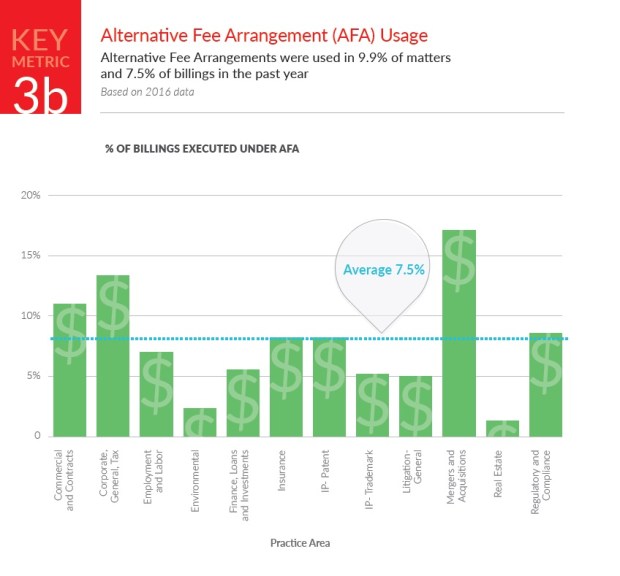
AFAs by billing.jpg

That’s right, what this table shows us is that some of the most “complicated, cannot tell you what will happen” work is being serviced on AFAs while other “commoditised” work, not so much.

This chart makes for quite compelling reading. Unfortunately it also tells me that only about 7.5% = on average – of all billable work is done on AFAs (without defining AFAs). Evidence like that is most likely going add to the voice that clients prefer being billed by the hour – which is a shame.

rws_01


Before you can kill the billable hour, you first need to get rid of utilisation

A lot has been written about a need to kill the billable hour. Some of it has merit. Lots of it doesn’t. Some of it has been written with the client’s benefit in mind, most of it hasn’t – in the it is written with law firm survival in mind.

Crucially, pretty much all of it is irrelevant.

How can I be allowed to say such a thing?

Because the reality is that under most law firm’s current performance regimes, we actively encourage the survival of the billable hour, even while we advocate for its death.

What do I mean by this?

Well, as I alluded to in my post last week, what consistently surprises me is that while many advocate for the death of the billable hour, with few exceptions most of these advocates fail to look at one of the principal underlying issues that makes its death – overnight or otherwise – near impossible:- utilisation.

Utilisation refers to the metric by which we determine how busy fee earners are. In most firms (although not all), to ascertain ‘utilisation’ we look at the annual budget of hours the firm has set the relevant fee earner (typically starting at 1,400 hours and going north) and we measure that against the amount of billable time they have put on their time-sheets (daily, weekly, monthly or annually). From this, we then decide how “busy” that fee earner has been.

But, it’s actually a crock of shit as a metric of measurement.

Why?

Because, it doesn’t tell us how much time the fee earner has worked on the business – e.g., KM time (typical requirement of an additional 40 hours) or pro bono time (maybe another 40+ hours – notice the reoccurring hour theme here?).

It doesn’t even actually tell me how busy the lawyer has been, heard of “desktop discounts” aka “leakage”.

But most important of all, it doesn’t tell me if you made any money at all, much less any profit!

What it does is assumes that you get 100% of your hourly rate paid – but as we have seen the reality is far from the truth insofar as that assumption goes.

So it’s an absolutely rubbish metric in my opinion.

But, and I kid you not when I say this, utilisation will determine the pay rise and bonus of pretty close to every lawyer (and by that I mean partner down) in Australia this year.

So, if we except that utilisation is a rubbish metric: why does it persist?

The answer to that question is, in my opinion, one of the principal reasons why we will never get rid of the billable hour under the current reward and benefit system – because it is perceived as being a fair metric of comparison.

What”, I hear you cry, “that’s madness!”.

But it’s true. In the modern ‘full service’ law firm, where billable hour rates vary according to the type of work we do, how busy we are is seen as a fairer metric of comparison than the rate we charge or the amount we earn – with the number of hours we work, Goddess of all.

So how ridiculous is all this really?

Well, in most firms as a lawyer working on the billable hour I’ll be better paid (including bonus) with 150% utilisation, 80% realisation and 15% net profit margin, than a lawyer working on fixed fees with 80% utilisation, 150% realisation and 40% net profit margin.

I’ll leave you to decide the madness of that.

rws_01
When is a billable hour not a billable hour? – and other billable hour issues!

realisation

When it’s about 48 minutes.

The ‘billable hour’ issue has reared its ugly head once again on LinkedIn in the past few days following [re-]publication of a post by Sue-Ella Prodonovich ‘Don’t Abandon The Hourly Rate Just Yet‘.

I’ll start this post by saying there’s a fair amount that Sue-Ella and I will never see eye to eye on about pricing and the billable hour, but core to my objection with this particular article of hers is the assumption that all ‘billable hours’ equal an ‘hour’, when all the data shows us, including the chart above, that it clearly does not.

Which brings me to the point of this post: what exactly is a ‘billable hour’?

My experience has been that the answer to this question is far more complicated than the question would at first blush suggest. That’s because, in reality, most firms don’t have a ‘billable hour’, they have several.

What do I mean by this?

This: fact, not only do most firms have several billable hour rates within the firm for different practice groups, but they also have several billable hour rates within the same practice group, to be used as the circumstances warrant.

Which is to say, a lawyer in a bog standard average corporate practice in Australia may well have a ‘rack rate’, a ‘discount rate’ (between 5 and 10 per cent, but possibly more) and a ‘do not go below rate’ – unless, that is, management has approved this as a loss leader so the firm can win other work, in which case we gave another rate: a win the work at any cost rate.

All of which is to say, not only is the term ‘billable hour’ rather meaningless; but, cruically, it is anything but fair and transparent.

So far as fairness goes, as I have advocated in the past, the billable hour is typically unfair to loyal paying customers because, more often than not, discounts on the billable hour are given to new clients while loyal clients pay a premium (if not full rack rate).

Don’t believe me, have a look at the 80/20 breakdown of your firm’s client base. I’ll bet you that the majority of your higher earning clients have a higher average billing rate – which, remember, under the billable hour system has little to do with complexity or value.

As I hope you will agree then, the ‘billable hour’ is a fairly meaningless metric, especially of comparison.

Importantly for clients, here are some of the things the billable hour  doesn’t do:

  • denote expertise – you are more likely to have a higher charge-out rate based on the number of years you have been alive on this planet than the number of relevant deals you have worked on;
  • denote value – unless what you are selling is your time;
  • promote speed and efficiencies – unless, that is, you have a penalty clause if you don’t complete within a certain time or a bonus clause if you do;
  • assist with transparency – because in order for transparency to exist you need to know upfront what you are getting and you don’t typically get to know what you have got until after the fact with the billable hour.

But I’ll wrap this post up by letting you in on a little secret: the real reason why, under current performance metrics used in Australian law firms, we will never get rid of the billable hour – and that is utilisation.

rws_01

Anyone know what’s going on at LinkedIn?

julian-li4-copy

(Julian Summerhayes update posted this week to LinkedIn)

I’ve just returned from paternity leave to turn on my computer and find that LinkedIn has undergone yet another ‘upgrade’ in my absence.

Before I left I was giving very serious thought to moving away from blogging here on WordPress and doing more (or, for that matter, my first) posts to LinkedIn directly.

Undoubtedly the publishing platform was growing in popularity among those I respect – including my good friend Julian Summerhayes (who inspired this post) – and an ever increasing number of posts in my weekly newsletter were being published directly to LinkedIn (as opposed to republished, which was very common about a year ago).

It all made sense. Then.

With the ‘upgrade’, that’s all changed.

Why?

Because I hate this latest, so-called, ‘upgrade’.

Some of the things that have immediately off-sided me (and I have yet to have a proper look under the bonnet so to speak) with this latest upgrade include having to go to a separate widget if I want to view or post to my Group, not being able to see updates in real time, and being dependent on LinkedIn’s algorithms to read my preferences (it doesn’t).

In the real scheme of things these changes are not material or major. LinkedIn will survive the fallout.

More importantly what it shows me is this:-

LinkedIn has had a concerted and somewhat successful strategy of late to move itself away from being a modern form of CRM database to becoming a major player in the online world of content aggregation and publishing.

With these ‘upgrades’, in my opinion this strategy is dead in the water.

Linekedin is, once again, little more than an address book.

rws_01


Another reason why law firms will never be considered innovative

Business Development image

Almost four years ago (5 March 2013), when I was blogging on a different platform (Australian law firm business development), I blogged that ‘Australian law firm offices to face foreign currency exchange woes?‘. In that post I stated that:

The importance of this [currency exchange fluctuations] becomes clear when you realise that Australian law offices who report back to an overseas head office could, in effect, have a numerical “loss” or “fall in revenue” of 10 to 20 per cent or more, without there being any real decrease in their domestic revenue/profit.

Worse, in order to keep their fellow partners happy in London, New York or Chicago, Australian-based partners will need to drastically increase their local revenue and profit without having the pleasure of their being credited with this on an international level! And keep in mind that all of this is taking place at a time when the market is becoming more competitive on a daily basis.

All I can say to that is – “best of luck”. Alternatively, maybe now is the time to call your bankers and to start getting involved in foreign exchange currency swap arrangements.

Bold and underline by me for emphasis.

Now why would I bring up a post I made almost 4 years ago?

Because, last week The American Lawyer reported: ‘As Currencies Suffer, Law Firms Try Hedging to Safeguard Revenues‘ in which they state:

To mitigate the uncertainty that comes with earning revenue in varied currencies, some law firms have started hedging currency, a practice that is more common among big multinational companies.

Overall revenue suffers when one or more of the currencies that make a firm’s revenue declines against the dollar, while pay discrepancies between partners in different countries widen if the foreign based-partners are paid in local currency.

So almost four years to the day after I suggested this, I’d now like to ask these same firms to read a post of mine from three years ago. It offers up some advice on another tactic they may want to consider.

rws_01


Death of the billable hour is nigh – really?

The billable hour has received a large number of death notices following the recent publication of Georgetown Law’s Centre for the Study of the Legal Profession and Peer Monitor’s ‘2017 Report on the State of the Legal Market‘.

The particular section of the Report that’s generating this excitement is this:

Death of Traditional Billable Hour Pricing. One of the most potentially significant, though rarely acknowledged, changes of the past decade has been the effective death of the traditional billable hour pricing model in most law firms. This isn’t to suggest that most firms have done away with billing based  on hours worked; indeed the majority of matters at most firms are still billed on an “hourly basis.” But  focus on that fact alone misses a fundamental shift that has occurred in the market. This change has been overlooked principally because of a definitional problem. In much of the writing on this subject, the focus has been on so-called alternative fee arrangements or “AFAs,” pricing strategies  that are based on fixed-price or cost-plus models that make no reference to billable hours in the calculation of fees. Since other pricing models typically incorporate some reference to billable hours, it has often been assumed that only AFAs are genuine non billable hour alternatives and every other approach is simply business as usual. That conclusion, however, overlooks a major shift that has occurred over the past decade: the widespread client insistence on budgets (with caps) for both transactional and litigation matters.

I’m not overly sure how they set caps in the US, but here in Australia I can say two things:- (1) we try very hard not to use caps as they are a lose-lose, and (2) where we have to set caps (and don’t get these confused with estimates), we go high – very high – because we know we are taking all the risk and none of the benefit!

Nope, caps are not, nor will they ever be, the death of the billable hour. Conversely, they are the life-support keeping the billable hour alive.

But, if you read the Report you will find evidence of a trend that shows you that the billable hour’s days have to be numbered, as seen in the following two charts:

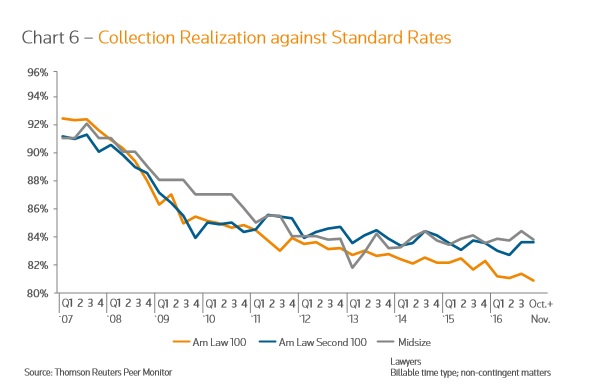
realisation

The first, a 10 year chart evidencing the death spiral of realization rates against largely arbitrary “standard rates” – whatever they are these days (fairly meaningless really).

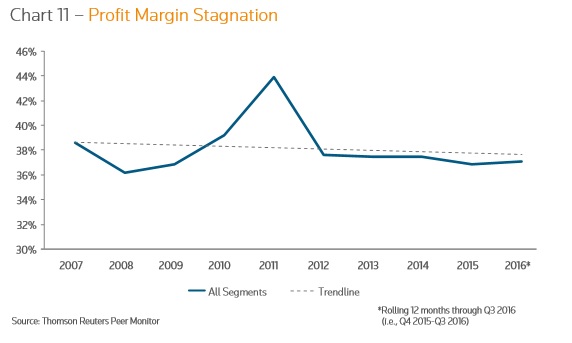
profit margin.jpg

The second, a 10 year look at profit margin stagnation (anyone else getting the feeling its said with some kind of contempt?) at roughly 38%.

So what story does this tell me and why do I think this has more to say in the death of the billable hour than any capped rate will?

Well, first off, you can only maintain a stagnant profit margin of 38% in a market with freefalling realization rates if (a) you increase rates by 10% or more per year but then discount on those ‘standard’ rates – and as I posted recently, that strategy cannot last forever, or (b) you cut costs to the bones.

Either way, if  you want to continue any kind of continuing profit margin in the high 30%s – and I’d be surprised if you could find me an equity partner who doesn’t!, then you going to need to think about changing the way you charge for the work you do.

It really is that simple. And that’s the real reason why this Report tells me the death of the billable hour is nigh.

rws_01